

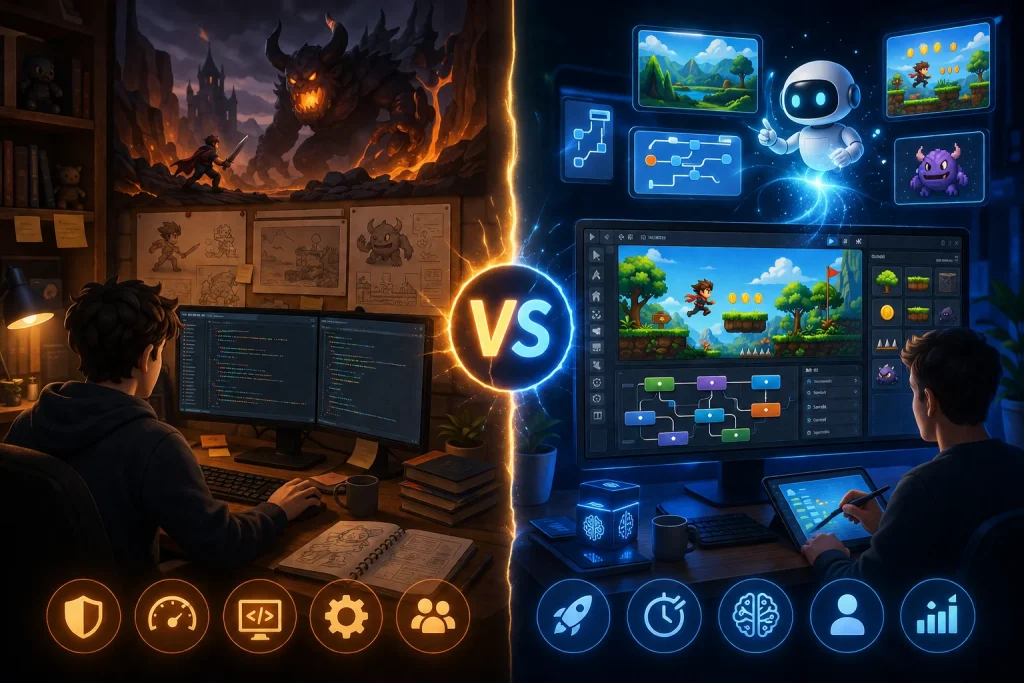
Framing this as a competition is where most discussions go wrong from the start. AI-assisted development and traditional coding aren’t really fighting for the same territory, they solve different problems, and the “which is better” question depends entirely on what you’re trying to build and how fast you need to get there.
Still, the comparison is worth making properly, because understanding where each approach actually shines helps you avoid picking the wrong one for your project.
What Traditional Game Development Actually Offers
Traditional development means writing code directly, whether that’s in a full engine like Unity or Unreal, or a lighter framework built for a specific genre. This approach has been the standard for decades, and for good reason.
Full Control Over Every System
Nothing is abstracted away. If you want a specific physics behavior, a custom rendering effect, or an unusual control scheme, you can build it exactly as imagined. There’s no platform ceiling limiting what’s technically possible, only your own skill and time.
Performance Optimization at a Deep Level
When a game needs to run smoothly with thousands of active objects or handle competitive multiplayer with minimal latency, hand-written code gives you access to optimization techniques that visual tools simply don’t expose. This matters enormously once a project scales past a prototype.
Long-Term Independence
A traditionally coded game doesn’t depend on any single platform’s continued existence. You own the codebase outright, which matters if you’re building something meant to last for years rather than a quick experiment.
The Tradeoff: Time and Skill Investment
None of this comes free. Learning to code well enough to build a polished game takes months, often years, of consistent effort. Every mechanic, no matter how simple, has to be built from lower-level pieces. That’s a real cost, and it’s the main reason traditional development doesn’t work for everyone with a good idea.
What AI-Assisted Development Actually Offers
AI-assisted platforms take a fundamentally different approach: instead of writing code, you describe what you want, and the tool translates that into working mechanics.
Speed From Idea to Playable Prototype
This is the biggest and clearest advantage. What might take weeks in traditional development can take hours with an AI-assisted platform. Game maker online tools are built around exactly this idea, letting creators generate a working game concept from a plain-language description rather than starting from a blank code editor.
Lower Barrier for Non-Programmers
Writers, designers, and people with strong creative instincts but no coding background finally have a direct path to building something playable. The idea itself becomes the primary asset again, rather than the ability to implement it technically.
Fast Iteration on Design, Not Just Code
Because changes don’t require touching underlying code, testing variations happens quickly. Want to see how the game feels with a different difficulty curve or a new mechanic layered in? Adjust and playtest almost immediately. Games like Smash the Dummy show how this kind of tight, well-paced core loop can come together quickly without sacrificing how satisfying it feels to play.
The Tradeoff: Ceiling on Complexity
Highly technical genres, physics-heavy simulations, competitive netcode, deeply custom rendering, still push against the limits of what AI-assisted tools can express. The abstraction that makes these platforms accessible is the same thing that eventually limits how far you can push a specific technical vision.
Comparing the Two Directly
Speed to First Playable Version
AI-assisted development wins decisively here. A rough prototype that used to take weeks can come together in a single sitting.
Long-Term Flexibility
Traditional coding wins here. Nothing is off-limits technically, and the project isn’t tied to any platform’s roadmap or pricing decisions.
Accessibility
AI-assisted tools win clearly. No years-long learning curve standing between an idea and a working version of it.
Performance at Scale
Traditional development still has the edge for anything pushing serious technical limits, competitive multiplayer, large open worlds, or heavy simulation work.
Cost of Testing an Idea
AI-assisted tools win by a wide margin. Validating whether a concept is fun costs a fraction of the time and effort compared to building it from scratch first.
Creative Ceiling
Traditional development has no ceiling, given enough skill and time. AI-assisted tools have a ceiling, though it’s higher than most people assume and keeps rising as the tools improve.
When Traditional Development Is the Better Choice
- You have a specific, technically demanding vision that requires custom systems
- Performance at scale is a core requirement, not an afterthought
- You’re building something meant to exist independently for years
- You already have, or plan to build, strong programming skills as part of the project’s value
When AI-Assisted Development Is the Better Choice
- You want to test whether an idea is actually fun before investing months into it
- You don’t have a programming background and don’t want that to gate your creativity
- Speed of iteration matters more than deep technical customization
- You’re building casual, social, or browser-based games where accessibility and fast load times matter more than heavy technical complexity
The Hybrid Approach Many Creators Actually Use
A growing number of developers don’t treat this as an either-or decision. They prototype quickly using AI-assisted tools, validate that the core loop is genuinely fun, and only then decide whether the project deserves a fully custom build. This captures the speed advantage of AI-assisted development without abandoning the option to go traditional once an idea proves itself.
Others stay entirely within AI-assisted platforms because their projects, casual games, social experiences, quick multiplayer titles, never actually need what traditional development offers. The limitations that would matter for a technically ambitious project simply don’t apply to theirs.
Final Thoughts
Neither approach is objectively better. Traditional development offers control and independence at the cost of time and skill investment. AI-assisted development offers speed and accessibility at the cost of a lower technical ceiling. The right choice depends entirely on what you’re building and what actually matters for that specific project.
The most useful question isn’t which approach wins in general. It’s which one gets your specific idea in front of real players fastest, without sacrificing what that idea actually needs to work.
