

In the world of modern manufacturing, efficiency and precision are paramount. Progressive fabrication has emerged as one of the most effective methods for producing high-volume metal components with exceptional accuracy and consistency. By combining multiple operations into a single, continuous process, progressive fabrication enables manufacturers to produce complex parts faster and more cost-effectively than traditional methods.
This comprehensive guide explores the fundamentals of progressive fabrication, including how the process works, the types of progressive dies used, material considerations, key benefits, and real-world applications across various industries.
What Is Progressive Fabrication?
Progressive fabrication is a manufacturing process that uses a progressive die to perform multiple operations on a metal strip in a single press stroke. As the metal strip moves through successive stations within the die, each station performs a specific operation—such as blanking, piercing, bending, or coining—until a completed part emerges at the end of the process.
The fundamental concept of progressive fabrication is straightforward: a flat metal coil or strip is fed into a stamping press, where a progressive die transforms it into a finished component through a series of sequential operations. Unlike single-station stamping, which requires multiple press strokes and manual handling, progressive fabrication produces completed parts with minimal human intervention.
How Progressive Fabrication Works
Understanding the mechanics of progressive fabrication is essential for appreciating its capabilities and limitations.
The Progressive Die
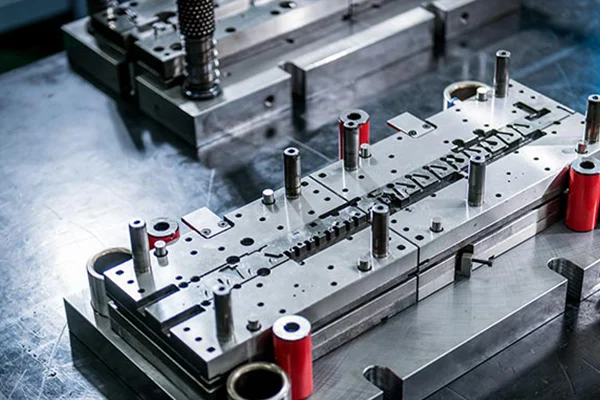
At the heart of progressive fabrication is the progressive die. This precision tool contains multiple stations, each designed to perform a specific operation. As the metal strip advances through the die, it passes from one station to the next, with each station building on the work of the previous ones.
In progressive fabrication, the die is typically mounted in a stamping press that provides the force needed to cut, form, or shape the metal. The press operates in a continuous cycle, advancing the strip a precise distance with each stroke.
Strip Advancement
The metal strip in progressive fabrication is advanced through the die using a feeding mechanism. The feed length—the distance the strip moves with each stroke—is precisely controlled to ensure that each operation aligns correctly with the material.
Pilot pins are used in progressive fabrication to locate the strip accurately at each station. These pins engage with pilot holes that are punched in the strip at the first station, ensuring consistent positioning throughout the process.
Sequential Operations
In progressive fabrication, each station performs a specific operation. A typical progressive die might include:
- Station 1: Piercing. Pilot holes are punched to locate the strip.
- Station 2: Blanking. The outline of the part is cut.
- Station 3: Forming. The part is bent or shaped.
- Station 4: Coining. Features are embossed or detailed.
- Station 5: Cutoff. The finished part is separated from the strip.
The specific operations and their sequence depend on the part design and requirements. In progressive fabrication, the goal is to complete all operations in a single pass through the press.
Types of Progressive Dies
Progressive fabrication employs several types of progressive dies, each suited to different applications and production requirements.
Conventional Progressive Dies
Conventional progressive dies are the most common type used in progressive fabrication. The metal strip moves through the die in a straight line, with operations performed at each station. These dies are suitable for a wide range of part geometries and production volumes.
Offset Progressive Dies
Offset progressive dies use an angled or staggered layout to accommodate larger parts or complex geometries. In progressive fabrication, offset dies allow for more efficient material utilization and can produce parts that would not fit in a conventional straight-line layout.
Side-Action Progressive Dies
Side-action progressive dies incorporate slides or cams that operate at an angle to the press stroke. In progressive fabrication, side-action dies are used for parts requiring features such as undercuts, side holes, or complex contours.
Materials Used in Progressive Fabrication
Material selection is critical to the success of progressive fabrication. The chosen material must not only meet the performance requirements of the final part but also be suitable for the progressive stamping process.
Commonly Used Materials
Steel is the most widely used material in progressive fabrication due to its strength, formability, and cost-effectiveness. Low-carbon steels, high-strength low-alloy (HSLA) steels, and advanced high-strength steels (AHSS) are all commonly processed through progressive fabrication.
Stainless Steel offers exceptional corrosion resistance and strength. It is used in progressive fabrication for medical devices, food processing equipment, and architectural applications. Stainless steel work-hardens during fabrication, requiring careful process control.
Aluminum provides a high strength-to-weight ratio and excellent corrosion resistance. It is increasingly popular in progressive fabrication for automotive, aerospace, and consumer electronics applications. However, aluminum has lower formability than steel and is more prone to cracking and springback.
Copper and Brass offer excellent electrical and thermal conductivity. These materials are highly formable and widely used in progressive fabrication for electrical components and heat exchangers.
Key Material Properties
Formability refers to the ability of a material to undergo plastic deformation without cracking. Materials with high formability can be drawn, bent, and stretched more readily in progressive fabrication.
Springback is the tendency of a material to return to its original shape after forming. This behavior must be accounted for in die design and process parameters in progressive fabrication.
Work Hardening occurs when a material becomes harder and stronger as it is deformed. Work-hardening materials require progressive forming in progressive fabrication to prevent cracking.
Surface Finish affects both the appearance and performance of the fabricated part. Material with a consistent, defect-free surface is essential for successful progressive fabrication.
Key Benefits of Progressive Fabrication
Progressive fabrication offers several significant advantages over traditional stamping methods.
High-Speed Production
One of the most significant benefits of progressive fabrication is speed. Progressive dies can operate at high speeds, often exceeding 400 strokes per minute. This high-speed production capability makes progressive fabrication ideal for high-volume manufacturing.
Reduced Labor Costs
Because progressive fabrication automates multiple operations in a single press, labor costs are significantly reduced. One press operator can oversee the production of complex parts that would otherwise require multiple machines and operators.
Consistent Quality
Progressive fabrication delivers exceptional consistency. Because all operations are performed in a single die, dimensional variation is minimized. Each part is produced identically, ensuring consistent quality across millions of parts.
Material Efficiency
Progressive fabrication optimizes material utilization. The strip layout can be designed to maximize the number of parts produced from each strip, minimizing scrap and reducing material costs.
Complex Geometries
Progressive fabrication can produce parts with complex geometries that would be difficult or impossible to achieve with other methods. Multiple operations can be combined in a single die, enabling the production of intricate parts with tight tolerances.
Minimal Handling
In progressive fabrication, parts are produced with minimal handling. The strip advances automatically, and finished parts are separated from the strip at the final station. This reduces the risk of damage and improves overall efficiency.
Design Considerations for Progressive Fabrication
Effective design is essential for successful progressive fabrication. Several key considerations should guide the design process.
Strip Layout
Strip layout is one of the most critical aspects of progressive fabrication design. The strip layout determines the arrangement of parts on the metal strip, the feed length, and the number of stations required.
In progressive fabrication, efficient strip layout maximizes material utilization and minimizes scrap. Advanced software tools can optimize strip layout for specific part geometries and material properties.
Part Orientation
The orientation of the part on the strip affects formability, material utilization, and tooling complexity. In progressive fabrication, parts should be oriented to take advantage of the material’s best properties.
Carrier Design
Carriers connect the part to the strip as it moves through the die. In progressive fabrication, carriers must be strong enough to support the part but easy to separate at the final station.
Pilot Holes
Pilot holes are used to accurately position the strip as it moves through the die. In progressive fabrication, pilot holes must be precisely located and sized to ensure consistent positioning.
Reliefs and Clearances
Reliefs and clearances are essential for preventing tool interference in progressive fabrication. Features such as undercuts, side holes, and complex contours require careful planning to ensure they can be produced without tool damage.
Applications of Progressive Fabrication
Progressive fabrication is used across virtually every industry. Common applications include:
Automotive components such as brackets, connectors, terminals, and structural parts benefit from progressive fabrication due to its efficiency and precision.
Electronics components including connectors, shielding, heat sinks, and lead frames are produced through progressive fabrication for their accuracy and conductivity.
Medical Devices such as surgical instruments, implant components, and diagnostic equipment housings rely on progressive fabrication for precision and cleanliness.
Consumer Goods like appliance parts, hardware, and decorative components are manufactured through progressive fabrication for cost-effectiveness and consistency.
Aerospace parts including structural brackets, housings, and fasteners use progressive fabrication for lightweight, high-strength components.
Common Challenges in Progressive Fabrication
While progressive fabrication offers many benefits, it also presents unique challenges.
Springback
Springback is one of the most significant challenges in progressive fabrication. Compensating for springback requires careful die design and often involves over-bending or coining operations.
Tool Wear
Tool wear is accelerated in progressive fabrication due to the high speeds and continuous operation. Regular maintenance and proper tooling materials are essential for maximizing die life.
Dimensional Variability
Dimensional variability can occur due to variations in material thickness, hardness, or lubrication. Statistical process control and rigorous inspection are essential for maintaining consistency in progressive fabrication.
Material Handling
Material handling is critical in progressive fabrication. The strip must be fed consistently, and finished parts must be collected without damage. Automated handling systems are often employed to manage these tasks.
Quality Control in Progressive Fabrication
Quality control is essential for successful progressive fabrication. Key methods include:
In-Process Inspection catches defects early in progressive fabrication, preventing large batches of non-conforming parts.
First Article Inspection (FAI) verifies that the first progressive fabrication part meets all specifications.
Statistical Process Control (SPC) monitors key process parameters and triggers corrective action when needed.
CMM and Optical Inspection provide accurate dimensional data for progressive fabrication parts.
Conclusion
Progressive fabrication is a sophisticated manufacturing process that enables the production of complex metal components with exceptional speed, precision, and cost-effectiveness. By combining multiple operations in a single die, progressive fabrication reduces labor costs, improves consistency, and maximizes material utilization.
Understanding the fundamentals of progressive fabrication—from die design and material selection to process optimization and quality control—is essential for manufacturers seeking to leverage this powerful technology. Whether producing automotive components, electronic parts, or medical devices, progressive fabrication offers a competitive advantage in today’s demanding manufacturing environment.
