

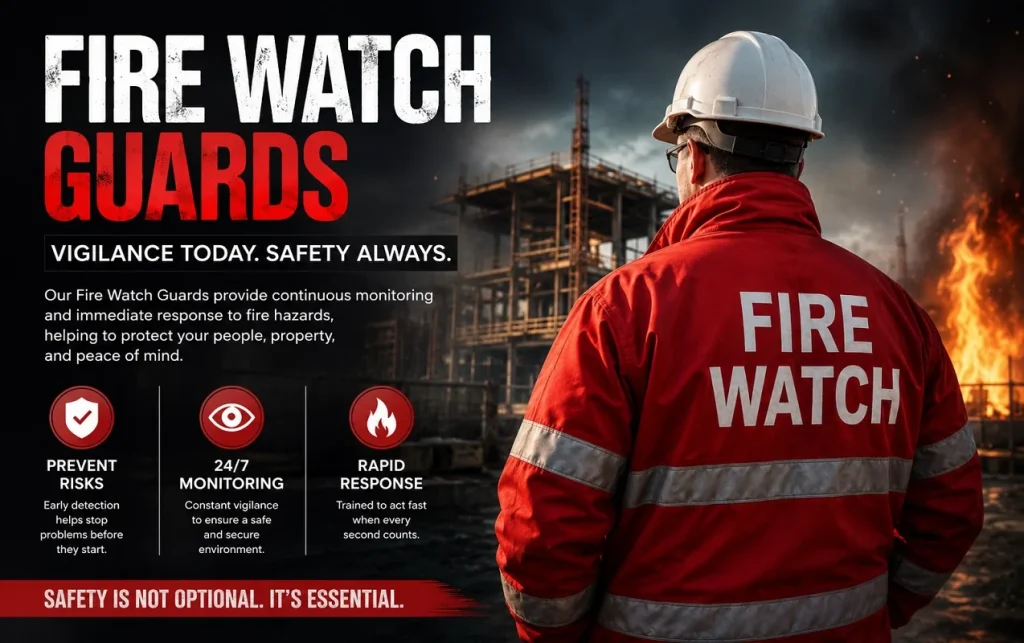
Why Every Business Needs Round-the-Clock Fire Protection
A single fire incident can wipe out years of hard work, inventory, and infrastructure in a matter of minutes. Businesses across industries face fire risks every day — from electrical faults and equipment failures to human error and natural causes. That’s why Fire Watch Guards have become an essential line of defense for commercial properties, construction sites, warehouses, and industrial facilities operating around the clock. Unlike automated systems that can malfunction or go offline during maintenance, trained fire watch personnel offer a consistent, human-powered layer of protection that technology alone simply cannot replicate. Their presence not only reduces risk but also ensures your business stays compliant with local fire safety codes.
What Exactly Is a Fire Watch Guard?
A fire watch guard is a trained security professional assigned to monitor a premises for fire hazards, especially when a building’s primary fire suppression or detection systems are temporarily disabled, under repair, or non-functional. These professionals patrol designated areas continuously, watching for early warning signs such as smoke, unusual heat, sparks, or open flames. They carry communication devices, fire extinguishers, and detailed patrol logs to document their observations throughout each shift. In many jurisdictions, hiring fire watch personnel is not just a smart business decision — it’s a legal requirement whenever a fire alarm or sprinkler system goes out of service for a specified period. Their training equips them to respond immediately to emergencies and coordinate with local fire departments when needed.
Industries That Rely on Fire Watch Services the Most
Fire watch services aren’t limited to one type of business — they serve a wide range of industries that face elevated fire risks on a daily basis.
- Construction sites where hot work like welding, cutting, and grinding creates immediate spark hazards
- Warehouses and logistics centers storing flammable materials, paper, and chemicals
- Hospitality venues including hotels and event spaces with high occupant loads
- Healthcare facilities during fire system upgrades or inspections
- Manufacturing plants running heavy machinery around the clock
- Retail centers and malls where large crowds increase evacuation complexity
- Film and entertainment productions using special effects, pyrotechnics, or generators on location
Each of these environments presents unique fire risks, and a one-size-fits-all approach rarely works. Reputable fire watch providers tailor their deployment strategy to match the specific layout, occupancy, and hazard profile of each client.
The Core Responsibilities of Fire Watch Guards on Duty
When a fire watch guard steps onto your property, their responsibilities go far beyond simply “keeping an eye out.” Their role is structured, disciplined, and highly detail-oriented. At the start of every shift, they conduct a thorough walkthrough to identify potential hazards such as blocked fire exits, improperly stored flammable substances, or malfunctioning electrical panels. Throughout their patrol, they maintain a written log of every round — noting the time, the areas covered, and any observations made. If a hazard is identified, they immediately alert management and, if necessary, the fire department. They also ensure that fire extinguishers are accessible, exits remain clear, and no unauthorized hot work is taking place. In the event of an actual fire, their role shifts to coordinating evacuation, containing the spread if safely possible, and communicating with emergency responders on the ground.
How Fire Watch Guards Differ From Standard Security Personnel
Many business owners make the mistake of assuming their regular security team can handle fire watch duties. This is a costly misconception. Standard security guards are trained for access control, theft prevention, and general surveillance — not fire hazard identification or emergency fire response. Fire Watch Guards, by contrast, undergo specialized training that includes fire behavior fundamentals, proper use of fire extinguishers, emergency evacuation procedures, hazardous material awareness, and coordination protocols with fire departments. Their patrol patterns are also specifically designed to cover fire-risk zones rather than general security perimeters. When businesses deploy untrained staff for fire watch, they expose themselves to significant legal liability, insurance complications, and most importantly, preventable tragedies. Choosing a provider that specializes exclusively in fire watch services ensures that the personnel on your site have the right skills for the right job.
Legal Requirements and Compliance Considerations
Fire watch regulations vary by city and state, but the underlying principle is consistent across most jurisdictions: when a building’s fire protection systems are compromised, an alternative safeguard must be put in place immediately. Most fire codes require that a fire watch be initiated within one hour of a fire alarm or sprinkler system going offline. The frequency of patrols, the documentation required, and the qualifications of the personnel are often outlined in the National Fire Protection Association (NFPA) standards, particularly NFPA 101 and NFPA 25. Failure to comply can result in heavy fines, forced shutdowns, and voided insurance claims. Businesses that partner with professional fire watch companies benefit from providers who stay current with evolving regulations, handle all required documentation, and provide compliance reports that hold up to inspection scrutiny.
Choosing the Right Fire Watch Company for Your Business
Not all fire watch companies offer the same level of service, and the difference between a mediocre provider and a great one can be the difference between a close call and a catastrophe. When evaluating options, businesses should look for providers with verifiable training credentials, a track record in their specific industry, 24/7 dispatches availability, and transparent pricing structures. Response time is another critical factor — the best companies can deploy fire watch personnel within hours of a request, not days. It’s also worth asking whether the company carries adequate liability insurance and whether their guards are W-2 employees with background checks or contract workers with less oversight. Companies like Just Fire Watch have built their reputation on fast deployment, industry-trained guards, and a client-first approach that prioritizes both safety and compliance.
The Real Cost of Ignoring Fire Watch Needs
Business owners sometimes balk at the cost of hiring fire watch services, viewing it as an unnecessary expense during a period when their regular fire systems are simply being serviced. But this short-term thinking can lead to devastating long-term consequences. A single fire event can result in property damage running into hundreds of thousands of dollars, business interruption losses, legal claims from employees or customers, and irreparable damage to brand reputation. Insurance companies are increasingly scrutinizing whether businesses followed proper fire watch protocols before a loss event — and if they didn’t, claims can be denied entirely. When you weigh the relatively modest cost of professional fire watch coverage against the financial and human toll of an undetected fire, the math becomes straightforward. Fire Watch Guards are not an overhead burden — they are a measurable investment in business continuity and people’s safety.
Technology and Fire Watch: A Complementary Approach
Modern fire watch services are increasingly integrating technology to enhance their effectiveness. Digital patrol management systems allow guards to log their rounds via mobile apps with GPS verification, giving clients real-time visibility into patrol activity. Some companies now use thermal imaging tools to help guards detect heat anomalies invisible to the naked eye, particularly useful in large warehouses or during post-construction inspections. Two-way radio systems and centralized monitoring dashboards allow supervisors to stay connected with on-site guards across multiple locations simultaneously. However, it’s important to understand that technology serves as a support tool — not a replacement for trained human judgment. A thermal camera can flag a hot spot, but it takes an experienced guard to assess whether it represents a genuine fire hazard, communicate the risk clearly, and take appropriate immediate action.
Protecting People Is Always the First Priority
At the heart of every fire watch operation is a simple but profound mission: protecting human lives. Buildings can be rebuilt, inventory can be restocked, and equipment can be replaced — but lives cannot. Businesses that invest in professional fire watch coverage are sending a clear message to their employees, customers, and stakeholders that safety is non-negotiable. A well-trained fire watch team serves as the bridge between a fire safety gap and a fully protected environment, ensuring that no period of vulnerability goes unguarded. Whether a business is undergoing a routine system upgrade, managing a large outdoor event, or operating in a high-risk industrial environment, having dedicated fire watch professionals on-site provides peace of mind that no automated system can fully deliver.
