

The phrase “whether or not” is deceptively small yet extremely powerful. It expresses conditional relationships, alternatives, and the independence of actions or outcomes, making it essential for effective communication in academic writing, business correspondence, professional reports, and daily conversation.
In this guide, you’ll find a comprehensive exploration of meaning, grammar, common mistakes, examples, practical exercises, NLP insights, and tips for mastery, ensuring you gain both understanding and confidence using this phrase.
1. What Does “Whether or Not” Mean?
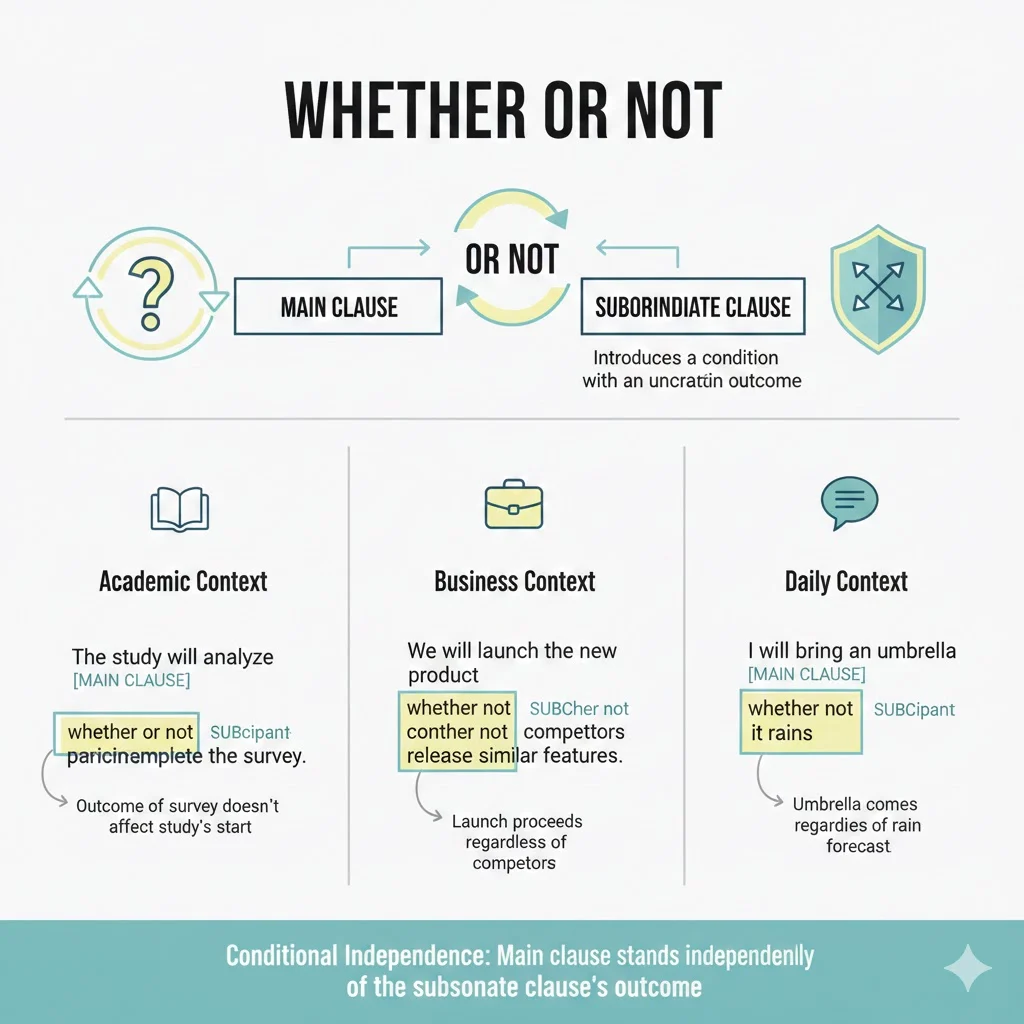
“Whether or not” is a conditional conjunction or discourse marker. It introduces alternatives while emphasizing that an action or outcome happens regardless of a specific condition.
Key Points:
- Expresses conditional independence
- Connects main and subordinate clauses
- Commonly used in formal and professional contexts
Examples:
- “I’ll attend the meeting whether or not it rains.”
- “She will submit the report whether or not she receives assistance.”
- “The program will run whether or not the server is fully online.”
From an NLP perspective, “whether or not” is tagged as a conditional connector that helps AI detect relationships between actions and conditions.
2. How “Whether or Not” Works in Sentences
It links a main clause with a subordinate clause. It typically signals that the action in the main clause is independent of the subordinate clause.
Structure:
[Main Clause] + whether or not + [Subordinate Clause]
Example:
- “He will finish the project whether or not he receives help.”
Here, finishing the project is independent of help.
Table 1: Conditional Clause Structure
| Sentence | Main Clause | Subordinate Clause | Meaning |
|---|---|---|---|
| I’ll attend whether or not it rains | I’ll attend | it rains | Action happens regardless of rain |
| She will succeed whether or not she has support | She will succeed | she has support | Success occurs independently |
| We will launch the product whether or not approvals are done | We will launch | approvals are done | Launch happens regardless |
2.1 Using “Whether or Not” in Questions
Although less common, it can be used in indirect questions:
- “I’m unsure whether or not she will join the meeting.”
- “We don’t know whether or not the system will update automatically.”
3. Difference Between “Whether” and “Whether or Not”
| Feature | Whether | Whether or Not |
|---|---|---|
| Meaning | Expresses doubt or alternative | Emphasizes independence of outcome |
| Example | “I don’t know whether she will come.” | “I’ll go whether or not she comes.” |
| Use | Informal & questions | Formal statements, instructions, conditional emphasis |
| NLP Role | Marks uncertainty | Marks conditional independence for AI parsing |
Tip: Use “whether or not” when the independence of action is important.
4. Common Mistakes to Avoid
- Using “if” instead of “whether”
- ❌ “I don’t know if I will attend, whether or not it rains.”
- ✅ “I don’t know whether I will attend, whether or not it rains.”
- Redundancy
- Avoid “whether or not or” or adding unnecessary conditions.
- Improper placement
- Correct: “We’ll continue the project whether or not funding arrives.”
- Incorrect: “Whether or not funding arrives, we’ll continue the project” (acceptable but less formal in some contexts).
- Overuse
- Sometimes “whether” alone is sufficient; avoid repetition in a single paragraph.
5. Examples Across Contexts
5.1 Academic Writing
- “The experiment will succeed whether or not external factors are ideal.”
- “Participants were included whether or not they met preliminary criteria.”
- “The study will continue whether or not all volunteers submit consent forms.”
5.2 Business Communication
- “We will proceed with the project whether or not additional funding is approved.”
- “The product launch is scheduled whether or not all approvals are complete.”
- “Team meetings will occur whether or not all members are present.”
5.3 Daily Conversation
- “I’ll cook dinner whether or not you help.”
- “She wears her favorite outfit whether or not it’s trendy.”
- “I’m going for a run whether or not it rains.”
Table 2: Usage Across Contexts
| Context | Example Sentence | Independence |
|---|---|---|
| Academic | “The study continues whether or not participants comply.” | High |
| Business | “Launch occurs whether or not testing is complete.” | High |
| Daily Life | “I’ll go for a run whether or not it rains.” | Medium |
6. Professional Writing Applications
“Whether or not” is highly valuable in professional settings:
- Email Examples:
- “We will submit the proposal whether or not all documents are ready.”
- “I will attend the board meeting whether or not the agenda is finalized.”
- Report Writing:
- “The system will operate whether or not external dependencies are met.”
- “Training sessions will continue whether or not all participants confirm attendance.”
Tip: Use bold or italics for emphasis in reports, ensuring clarity for formal readers.
7. Creative & Conversational Use
In creative writing or dialogue, it expresses determination, independence, or persistence:
- “He followed his dreams whether or not anyone believed in him.”
- “She danced under the stars whether or not anyone was watching.”
Casual conversation:
- “I’ll try the new restaurant whether or not you join me.”
- “I’m going to learn the song whether or not I have time.”
8. NLP Insights: AI and “Whether or Not”
From an NLP perspective, “whether or not” is a conditional discourse marker.
- NER (Named Entity Recognition): Not a named entity; tagged as a connector
- Dependency Parsing: Links main verbs to subordinate clauses
- Semantic Role Labeling (SRL): Marks conditions that influence actions
Example Parsing:
- Sentence: “She will succeed whether or not she gets support.”
- Main verb: succeed
- Conditional clause: whether or not she gets support
- Semantic role: independence of outcome
9. Exercises for Practice
Fill in the blanks:
- I’ll attend the workshop ______ it rains. → whether or not
- The project will continue ______ the team finishes on time. → whether or not
- She reads every book ______ it is popular or not. → whether or not
Rewrite the sentences with “whether or not”:
- “I will submit the assignment even if I get help.” → “I will submit the assignment whether or not I get help.”
- “We will hold the meeting even if some members are absent.” → “We will hold the meeting whether or not some members are absent.”
Tip: Practice enhances both grammatical accuracy and writing confidence.
10. Advanced Tips for Mastery
- Use “whether or not” to emphasize independence of outcome.
- Avoid unnecessary repetition; sometimes “whether” is enough.
- Pair with future tense for clarity in formal writing.
- Include in academic, business, or professional documents for precision.
- Integrate in dialogue or creative writing to express determination or persistence.
11. FAQs
Q1: Can I use “whether or not” in informal writing?
A: Yes, but “whether” often suffices unless you want to emphasize independence.
Q2: Is “whether or not” the same as “regardless of”?
A: Similar in meaning, but “whether or not” is a conjunction while “regardless of” is a prepositional phrase.
Q3: Can AI detect “whether or not”?
A: Yes. NLP models recognize it as a conditional connector, useful for semantic parsing.
Q4: What are common mistakes with “whether or not”?
A: Misusing “if,” redundancy, and incorrect placement are common errors.
Q5: How does “whether or not” differ from “if”?
A: “If” expresses a condition that may or may not happen; “whether or not” emphasizes independence of the main action.
12. Conclusion
“Whether or not” is a small but essential phrase that adds clarity, precision, and authority to English writing. Mastery of this phrase ensures you can:
- Communicate independent actions clearly
- Write professionally, academically, and conversationally
- Avoid common mistakes and maintain formal tone
- Integrate understanding into NLP and AI frameworks
Whether you are drafting emails, writing reports, or teaching English, using “whether or not” correctly demonstrates skill and confidence.