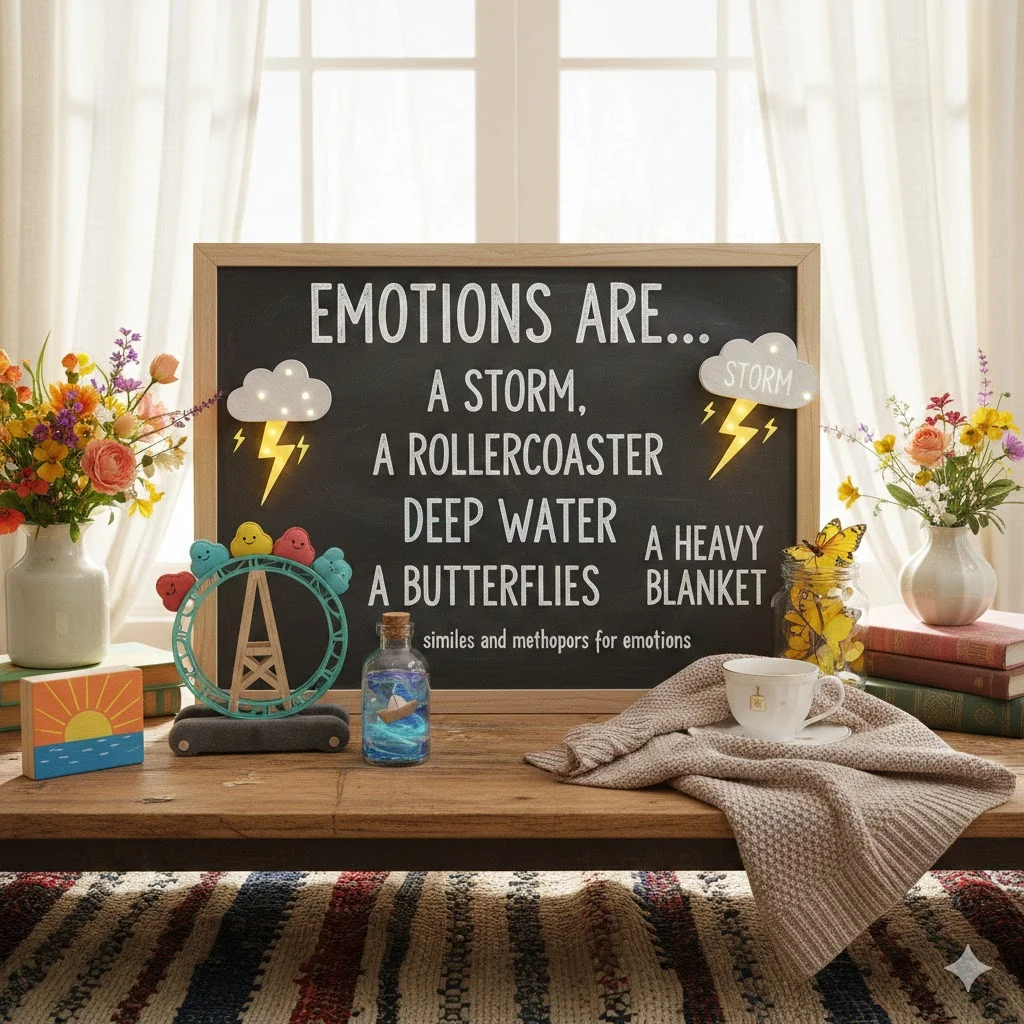

Emotions are the vibrant colors of our inner world, painting our thoughts and experiences with hues that words often struggle to capture. Like a stormy sky or a gentle sunrise, feelings can be intense, fleeting, or tender—and yet, expressing them accurately can transform mere words into vivid stories. Similes and metaphors serve as bridges between the abstract and the tangible, giving our emotions shape, texture, and depth.
Imagine anger as a bubbling volcano ready to erupt, or joy as a sunbeam breaking through heavy clouds. These comparisons do more than describe—they make emotions tangible, relatable, and memorable. Understanding and using similes and metaphors for emotions not only enhances creative writing but also nurtures empathy, helping readers feel what the writer feels. In this guide, we’ll explore a diverse collection of similes and metaphors for emotions, each designed to make emotional expression rich, colorful, and unforgettable.
Whether you’re a writer, teacher, or parent, these expressive tools will help children and adults alike articulate the swirling currents of the heart with clarity and imagination. By the end of this article, you’ll have a treasure trove of imagery that transforms abstract feelings into living, breathing experiences.
1. Happy as a Lark
Meaning: Feeling joyful, light-hearted, and carefree.
Examples in Prose:
Formal: She was happy as a lark after receiving the promotion, her smile brightening the office.
Casual: I felt happy as a lark when my friends surprised me with a birthday cake.
Example in Poetry:
Her laughter soared, happy as a lark,
Chasing shadows from the dark.
2. Angry as a Thunderstorm
Meaning: Feeling intense anger or rage.
Examples in Prose:
Formal: He was angry as a thunderstorm when his report was rejected without explanation.
Casual: I was angry as a thunderstorm when someone cut in front of me in line.
Example in Poetry:
Fury raged like lightning in the night,
Burning bridges with blinding light.
3. Nervous as a Cat in a Room Full of Rocking Chairs
Meaning: Feeling anxious or tense, anticipating potential danger.
Examples in Prose:
Formal: She felt nervous as a cat in a room full of rocking chairs before presenting her thesis.
Casual: I was nervous as a cat in a room full of rocking chairs before my school play.
Example in Poetry:
Whiskers twitching, heart on edge,
Treading lightly near the ledge.
4. Sad as a Rainy Day
Meaning: Feeling sorrowful, gloomy, or melancholic.
Examples in Prose:
Formal: He was as sad as a rainy day after hearing about the loss of his childhood friend.
Casual: I felt as sad as a rainy day when my pet got sick.
Example in Poetry:
Tears fell gently, sad as rain,
Echoing sorrow, echoing pain.
5. Excited as a Kid in a Candy Store
Meaning: Feeling thrilled, eager, or full of anticipation.
Examples in Prose:
Formal: She was excited as a kid in a candy store when she received her first scholarship letter.
Casual: I felt excited as a kid in a candy store when I opened the gift box.
Example in Poetry:
Eyes wide with delight, heart racing fast,
Moments of joy I wished would last.
6. Lonely as a Cloud
Meaning: Feeling isolated or disconnected.
Examples in Prose:
Formal: He felt lonely as a cloud after moving to a new city and leaving his friends behind.
Casual: I felt lonely as a cloud when everyone went home, and I stayed behind.
Example in Poetry:
Floating high, lonely as a cloud,
Silent whispers, soft and loud.
7. Calm as a Lake
Meaning: Feeling peaceful, serene, and composed.
Examples in Prose:
Formal: She remained calm as a lake despite the chaos around her.
Casual: I was calm as a lake while waiting for my turn on stage.
Example in Poetry:
Still waters mirror the sky above,
Calm as a lake, silent as love.
8. Brave as a Lion
Meaning: Feeling courageous, bold, and fearless.
Examples in Prose:
Formal: The firefighter was brave as a lion when entering the burning building.
Casual: I felt brave as a lion while giving my first speech in class.
Example in Poetry:
Heart of courage, fierce and bright,
Brave as a lion in the fight.
9. Confused as a Maze
Meaning: Feeling puzzled, uncertain, or lost.
Examples in Prose:
Formal: He was confused as a maze when trying to navigate the complex instructions.
Casual: I felt confused as a maze while trying to solve the tricky puzzle.
Example in Poetry:
Twisting paths with no clear way,
Confused as a maze, I stray.
10. Overwhelmed as a Flood
Meaning: Feeling buried by tasks, emotions, or situations.
Examples in Prose:
Formal: She was overwhelmed as a flood with the sudden influx of urgent emails.
Casual: I felt overwhelmed as a flood with all the homework piling up.
Example in Poetry:
Rushing waves engulf my mind,
Overwhelmed as a flood, confined.
11. Hopeful as a Sunrise
Meaning: Feeling optimistic, positive, and expecting good things.
Examples in Prose:
Formal: He was hopeful as a sunrise, confident that a solution would soon emerge.
Casual: I felt hopeful as a sunrise when I saw my lost phone had been found.
Example in Poetry:
Golden light breaks the night,
Hopeful as a sunrise, warm and bright.
12. Jealous as a Green-Eyed Monster
Meaning: Feeling envious or resentful.
Examples in Prose:
Formal: She was jealous as a green-eyed monster when her colleague received the award.
Casual: I felt jealous as a green-eyed monster when my friend got the last slice of pizza.
Example in Poetry:
Eyes of green with silent spite,
Jealous as a monster in the night.
13. Energetic as a Cheetah
Meaning: Feeling lively, active, and full of energy.
Examples in Prose:
Formal: He was energetic as a cheetah during the morning workout session.
Casual: I felt energetic as a cheetah after drinking my morning smoothie.
Example in Poetry:
Swift and bright, I run and play,
Energetic as a cheetah each day.
14. Lonely as an Island
Meaning: Feeling isolated, detached, or emotionally distant.
Examples in Prose:
Formal: She felt lonely as an island after her friends moved away.
Casual: I felt lonely as an island when nobody came to the park with me.
Example in Poetry:
Surrounded by endless sea,
Lonely as an island, just me.
15. Tired as a Sleepy Owl
Meaning: Feeling exhausted or drained.
Examples in Prose:
Formal: He was tired as a sleepy owl after the long overnight shift.
Casual: I felt tired as a sleepy owl after finishing the marathon.
Example in Poetry:
Heavy eyes, wings droop low,
Tired as a sleepy owl in the snow.
16. Frustrated as a Knot
Meaning: Feeling irritated, stuck, or unable to resolve a problem.
Examples in Prose:
Formal: She was frustrated as a knot when her presentation kept freezing.
Casual: I felt frustrated as a knot trying to untangle my necklace.
Example in Poetry:
Twist and turn, no end in sight,
Frustrated as a knot tonight.
17. Peaceful as a Meadow
Meaning: Feeling calm, relaxed, and harmonious.
Examples in Prose:
Formal: He felt peaceful as a meadow while meditating in the garden.
Casual: I felt peaceful as a meadow lying on the grass, watching clouds drift.
Example in Poetry:
Soft green grass beneath the sky,
Peaceful as a meadow, I lie.
18. Lonely as a Shadow
Meaning: Feeling unnoticed, isolated, or left out.
Examples in Prose:
Formal: She felt lonely as a shadow during the lively party.
Casual: I felt lonely as a shadow when everyone else was laughing together.
Example in Poetry:
Fading light, unseen by all,
Lonely as a shadow on the wall.
19. Sad as a Wilted Flower
Meaning: Feeling sorrowful, neglected, or fading in spirit.
Examples in Prose:
Formal: He was sad as a wilted flower when his favorite plant died.
Casual: I felt sad as a wilted flower after my ice cream fell on the ground.
Example in Poetry:
Petals droop with heavy sighs,
Sad as a flower, no sun in skies.
20. Excited as Fireworks
Meaning: Feeling exhilarated, thrilled, or bursting with emotion.
Examples in Prose:
Formal: She was excited as fireworks during the grand opening ceremony.
Casual: I felt excited as fireworks when I heard we were going to Disneyland.
Example in Poetry:
Colors explode across the night,
Excited as fireworks, pure delight.
Conclusion
Similes and metaphors for emotions are powerful tools that breathe life into writing. They transform abstract feelings into vivid imagery, making emotions not just readable but viscerally felt. From joy to sorrow, excitement to frustration, using these comparisons helps writers create relatable and memorable content that resonates with readers.
Whether you are teaching children, writing poetry, or crafting a compelling story, similes and metaphors elevate your expression, giving words wings to soar beyond ordinary descriptions. They nurture creativity, empathy, and understanding—turning feelings into experiences. Embrace these literary devices to make your writing richer, more emotional, and unforgettable.