
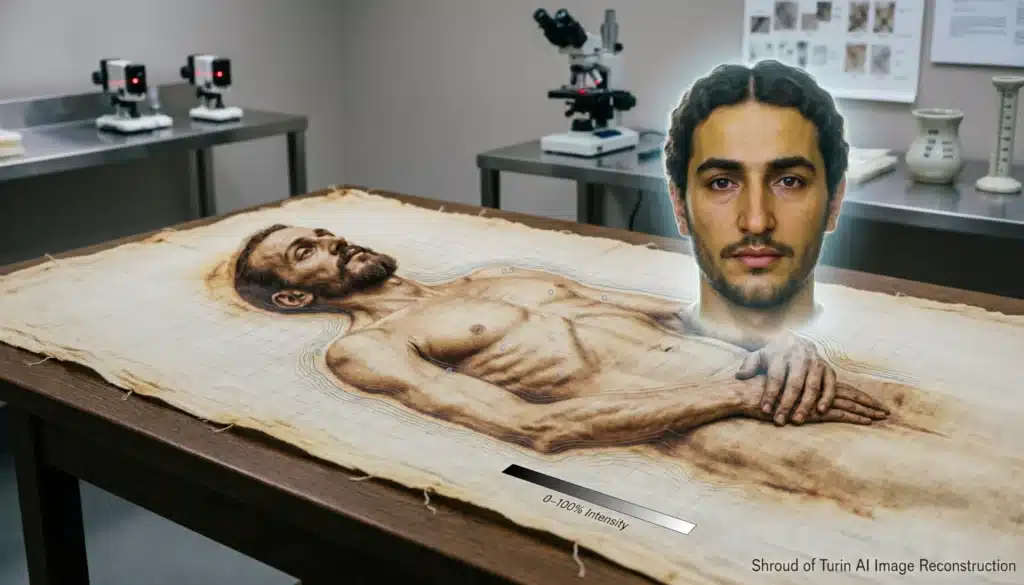

The shroud of turin ai image has exploded across the internet. Viral posts claim artificial intelligence has revealed the “real face of Jesus.” Others insist AI proves authenticity. Some say it debunks everything.
So what’s actually happening?
This guide cuts through hype. You’ll learn:
- What the Shroud of Turin really is
- How AI image processing works on ancient cloth artifacts
- What AI reconstructions actually show
- Whether AI can verify authenticity
- Where science stands right now
No fluff. No mystical leaps. Just facts, technical clarity, and careful reasoning.
What Is the Shroud of Turin?
The Shroud of Turin is a linen cloth measuring approximately 4.4 meters long and 1.1 meters wide (14.3 ft × 3.7 ft). It bears a faint image of a man who appears to have been crucified.
It is kept in the Cathedral of Saint John the Baptist in Turin, Italy.
Physical Characteristics
| Feature | Data |
|---|---|
| Length | 4.4 meters |
| Width | 1.1 meters |
| Weave Type | 3:1 herringbone twill |
| Image Type | Superficial discoloration on top fibrils |
| Visible Marks | Scourge wounds, crucifixion marks, side wound |
The image is not painted.
There are no brush strokes.
No pigment binder has been conclusively identified.
The coloration affects only the outermost linen fibers. It penetrates roughly 200 nanometers deep. That’s thinner than a human hair’s outer coating.
That detail matters when we talk about AI image enhancement.
Why the Shroud Became a Digital and AI Target
In 1898, photographer Secondo Pia discovered something remarkable. When he developed his photographic negative of the Shroud, the negative appeared more detailed and lifelike than the cloth itself.
The Shroud behaves like a photographic negative.
Fast forward to the digital era. High-resolution scans became available. Researchers digitized the 1931 Enrie photographs and the 1978 STURP datasets.
Once digitized, the artifact entered the world of:
- Computer vision
- Neural networks
- Super-resolution imaging
- 3D surface modeling
That’s when the shroud of turin ai image trend began.
What Does “Shroud of Turin AI Image” Actually Mean?
When people search for:
- shroud of turin ai image of jesus
- jesus christ shroud of turin ai image
- shroud of turin face ai
- shroud of turin digital reconstruction
They usually mean one of four things.
AI Enhancement
Improving clarity of existing scans using:
- Super-resolution models
- Denoising algorithms
- Contrast enhancement
This does not add new data.
It clarifies what already exists.
AI Reconstruction
Converting grayscale intensity into a 3D surface model.
This produces:
- Facial depth simulation
- Nose projection
- Cheek structure modeling
AI Generation
Using generative models to create a realistic human portrait based on Shroud data.
This often involves creative interpolation.
AI Authenticity Analysis
Applying machine learning to:
- Fiber degradation patterns
- Bloodstain geometry
- Image formation consistency
Each category serves a different purpose. Many viral posts blur these distinctions.
How AI Image Processing Works on the Shroud
Let’s break it down technically.
Digital Preprocessing Stage
Before AI does anything, the image undergoes:
- Grayscale normalization
- Background subtraction
- Burn mark masking
- Bloodstain isolation
This prepares the image for machine learning models.
Deep Learning Enhancement Techniques
Super-Resolution Neural Networks
AI models like ESRGAN upscale images while predicting fine detail.
Input: low-resolution scan
Output: sharper high-resolution image
These systems are trained on millions of natural images. That creates a limitation.
They infer details statistically. They do not recover lost original data.
Cloth Imprint to 3D Mapping
The Shroud image has a unique property. Image intensity correlates with cloth-to-body distance.
Researchers discovered this in 1976 using a VP-8 Image Analyzer.
Here’s how AI replicates that today:
- Convert brightness to elevation values
- Create depth map
- Apply smoothing filters
- Render 3D mesh
Simplified Workflow
| Step | Function | Result |
|---|---|---|
| Intensity Mapping | Brightness to depth | Elevation model |
| Noise Reduction | Remove artifacts | Cleaner mesh |
| Surface Rendering | Apply lighting | 3D face |
| Texture Overlay | Add colorization | Human-like portrait |
This process produces the shroud of turin 3d ai model images circulating online.
Shroud of Turin AI Reconstruction: What the Face Shows
AI reconstructions consistently display:
- Long hair
- Beard
- Prominent nose
- Closed eyes
- Facial trauma consistent with scourging
Some AI models also simulate:
- Skin texture
- Swelling around cheekbones
- Dried blood patterns
However, interpretation varies.
Different neural models produce slightly different faces.
Why?
Because AI fills gaps based on training data patterns.
The Limits of AI Reconstruction
Let’s be precise.
AI reconstruction relies on assumptions:
- The cloth draped evenly
- The intensity mapping is linear
- No distortion occurred during burial
These assumptions may not fully hold.
Even small distortion changes facial geometry.
What AI Cannot Do
AI cannot:
- Confirm identity
- Prove divinity
- Verify 1st-century origin
- Detect miracles
It processes pixels. That’s it.
Radiocarbon Dating and the AI Debate
In 1988, three laboratories tested samples of the Shroud.
Results dated the cloth between 1260 and 1390 CE.
That places it in the medieval period.
Some researchers argue:
- Sample contamination
- Rewoven repair areas
- Carbon monoxide absorption
However, no new official radiocarbon test has overturned the 1988 results.
AI image processing does not alter carbon dating data.
AI Analysis of Authenticity
Now let’s address a major question:
Can AI determine whether the Shroud is authentic?
Machine Learning Pattern Analysis
AI can analyze:
- Blood flow direction
- Wound consistency
- Anatomical alignment
- Symmetry patterns
For example:
Scourge wounds appear consistent with Roman flagrum patterns.
Blood flows align with gravitational positioning of crucifixion.
However:
Consistency does not equal authenticity.
Medieval artists could have understood crucifixion anatomy.
Before and After: AI Enhancement vs Original Image
AI enhancement increases clarity.
But clarity isn’t truth.
Here’s the difference:
| Feature | Original Scan | AI Enhanced |
|---|---|---|
| Contrast | Low | High |
| Edge Definition | Faint | Sharpened |
| Facial Outline | Blurred | Defined |
| Texture | Grainy | Smoothed |
Over-processing can create hallucinated detail.
That means AI invents subtle features.
This is common in neural super-resolution.
Shroud of Turin AI Image of Jesus: Why It Goes Viral
The phrase AI image of Jesus from shroud spreads rapidly because it triggers emotional response.
People want certainty.
AI images look authoritative.
But emotional impact does not equal scientific validation.
The Role of Generative AI
Some creators use generative models like diffusion systems.
They input:
- Shroud facial region
- Middle Eastern phenotype prompts
- First-century Jewish male descriptors
The AI outputs a photorealistic portrait.
This is creative reconstruction.
It blends historical anthropology with machine prediction.
It is not a photograph from 33 CE.
Scientific Evaluation Framework
To evaluate a shroud of turin ai image analysis, apply these criteria:
Data Integrity
- Was original high-resolution scan used?
- Were burn areas masked?
Model Transparency
- Was algorithm disclosed?
- Is training data documented?
Reproducibility
- Can others replicate results?
Bias Risk
- Was generative fill used?
- Were aesthetic filters applied?
Without transparency, claims weaken.
Theological Perspective on AI Reconstructions
The Catholic Church does not declare the Shroud authentic doctrine.
It calls it an object of devotion.
AI images do not change theological position.
Faith traditions operate independently of neural networks.
Ethical Concerns Around AI Religious Visualization
Several issues arise:
- Misinformation risk
- Manipulated images
- Deepfake-style misuse
- Commercial exploitation
Clarity in labeling is essential.
An AI-generated portrait should be labeled as such.
Forensic Facial Reconstruction AI vs Shroud AI
Let’s compare disciplines.
| Field | Purpose | Reliability |
|---|---|---|
| Forensic AI | Identify unknown remains | Moderate |
| Archaeological Reconstruction | Rebuild ancient faces | Interpretive |
| Shroud AI Reconstruction | Model cloth imprint | Experimental |
Forensic reconstructions use skull measurements.
Shroud reconstructions rely on cloth shading.
The difference is substantial.
Can AI Reveal the Real Face of Jesus?
Short answer: No.
Long answer:
AI can reconstruct a face from cloth shading patterns.
It cannot confirm historical identity.
There are no verified physical remains of Jesus for comparison.
There are no DNA samples.
Identity confirmation is impossible.
High-Resolution AI Image of the Shroud
Modern AI can upscale Shroud images to 8K resolution.
But remember:
Upscaling increases pixels.
It does not increase historical truth.
Technical Breakdown: AI Image Processing Pipeline
Below is a simplified engineering diagram in text form.
Raw Scan
   ↓
Noise Filtering
   ↓
Contrast Equalization
   ↓
Depth Mapping
   ↓
3D Mesh Generation
   ↓
Texture Rendering
   ↓
Optional Generative Enhancement
Each stage introduces potential interpretation.
Shroud of Turin AI Controversy
Controversy centers on three claims:
- AI proves authenticity
- AI disproves medieval origin
- AI reveals exact appearance of Jesus
None are scientifically confirmed.
AI visualizations are tools.
They are not historical verdicts.
The Role of Confirmation Bias
When viewers see a realistic face, they assume truth.
This is psychological projection.
AI outputs match expectation.
Expectation shapes interpretation.
Future of AI in Historical Artifact Analysis
AI technology continues advancing.
Emerging methods include:
- Hyperspectral imaging
- Fiber aging simulation
- Machine-learning textile pattern comparison
These tools may refine understanding of cloth manufacturing era.
However, authenticity debates require multidisciplinary consensus.
Summary of Key Facts
- The Shroud measures 4.4 × 1.1 meters
- Carbon dating places it between 1260–1390 CE
- AI enhances clarity but does not add historical data
- 3D modeling uses brightness-to-depth correlation
- Generative AI can create realistic portraits
- AI cannot confirm identity
Final Verdict on the Shroud of Turin AI Image
The shroud of turin ai image represents:
- A powerful digital reconstruction
- A compelling visual interpretation
- A technological application of machine learning
- Not definitive proof of authenticity
- Not verified historical portrait confirmation
AI amplifies visibility.
- It does not rewrite radiocarbon results.
- It clarifies patterns.
- It does not validate miracles.