

You’re typing an email to your boss. Your fingers fly across the keyboard, and you write: “The project was challenging, moreso because we had limited time.”
You pause. Something feels off.
Is it “moreso” or “more so”? Should there be a space? You’ve seen it written both ways online, and now you’re second-guessing yourself.
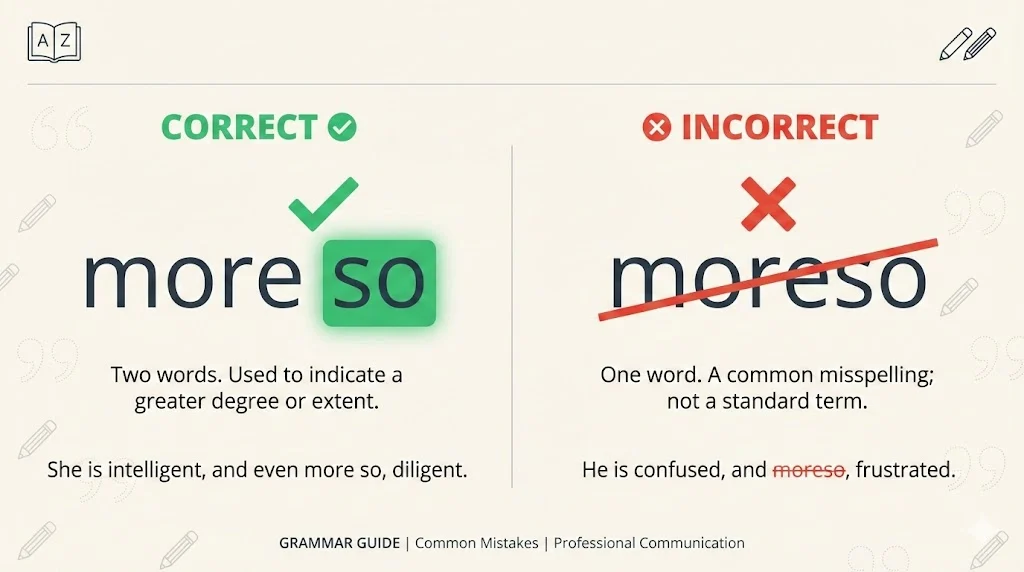
Here’s the answer you need right now: “More so” (two words) is correct. “Moreso” is a misspelling that doesn’t appear in any major dictionary.
This isn’t some obscure grammar rule that only English professors care about. This mistake shows up everywhere—in professional emails, published articles, and even marketing copy from major brands. It’s one of those errors that makes readers pause and question your attention to detail.
In this guide, I’ll break down exactly why “more so” requires a space, show you how to use it correctly, and explain why so many people get this wrong. You’ll walk away knowing the rule cold, plus you’ll see real examples that’ll stick in your memory.
Let’s clear up this confusion once and for all.
Quick Answer
Before we dive deep, let’s establish the foundation.
“More so” functions as an adverbial phrase in English. That means two separate words working together to modify a verb, adjective, or another adverb. You’d never write “even more” as “evenmore” or “much less” as “muchless,” right? The same logic applies here.
Major dictionaries unanimously reject the one-word spelling:
- Merriam-Webster Dictionary: Lists “more so” but not “moreso”
- Oxford English Dictionary: Recognizes only the two-word form
- Cambridge Dictionary: Shows “more so” as standard usage
- American Heritage Dictionary: No entry for “moreso”
Every major style guide agrees:
- The Chicago Manual of Style: Two words
- AP Stylebook: Two words
- MLA Handbook: Two words
- APA Publication Manual: Two words
There’s literally zero debate among language authorities. If you’re writing “moreso” as one word, you’re making an error—plain and simple.
Why This Mistake Happens So Often
You’re not alone if you’ve stumbled over this. Several factors make “moreso” look deceptively correct:
The compound word illusion tricks your brain. English has legitimate one-word compounds like “therefore,” “moreover,” “also,” and “however.” Your mind groups “moreso” with these words because they feel similar. But historical usage never supported merging “more” and “so.”
Fast typing creates muscle memory errors. When you’re flying through a draft, your fingers naturally want to keep moving. Adding a space requires a slight pause, and your typing rhythm might skip right over it.
Autocorrect doesn’t always catch it. Depending on your software, “moreso” might slip through without a red squiggle. Some older spell-checkers don’t flag it as an error, which reinforces the wrong pattern.
Informal online writing has normalized the mistake. You’ll spot “moreso” in blog comments, social media posts, and forum discussions. When you see something repeatedly, your brain starts accepting it as normal—even when it’s wrong.
What “More So” Actually Means
Understanding how “more so” works will help you use it correctly and catch errors when they pop up.
Definition and Function
“More so” acts as an intensifier or degree modifier in sentences. It emphasizes that something is true to a greater extent than what came before.
Think of it as a way to say “even more” or “to a greater degree” without using those exact phrases.
The phrase combines two elements:
- “More” = comparative degree (indicating increase)
- “So” = adverb meaning “to such an extent” or “in such a manner
Together, they create emphasis without forming a compound word. The space between them matters grammatically because each word maintains its individual function.
How It Builds on Previous Points
“More so” typically appears after you’ve made a statement, then you want to amplify or clarify it.
Consider this example:
“The presentation was impressive. More so when you consider the team only had three days to prepare.”
The first sentence establishes a baseline (impressive presentation). The second sentence uses “more so” to heighten that assessment by adding context.
Here’s another:
“She excels at problem-solving, more so than anyone else on the team.”
You’ve stated her strength, then “more so than” creates a comparison that emphasizes just how exceptional she is.
The Emphasis Factor
“More so” adds punch to your writing. It signals to readers: “Pay attention—this part matters even more.”
Without it: “The deadline was tight because we lost two team members.”
With it: “The deadline was tight, more so because we lost two team members.”
See the difference? The second version creates stronger emphasis on the reason behind the tight deadline.
How to Use “More So” Correctly (With Real Examples)
Let’s get practical. Here are the main ways you’ll use “more so” in your writing, with examples that show the pattern clearly.
After Making a Comparison
This is probably the most common usage. You’re comparing two things, and “more so” emphasizes one over the other.
Pattern: X is true, more so than Y
Examples:
- “I appreciated the feedback, more so than the actual grade.”
- “The software helps small businesses, more so than enterprise clients.”
- She values creativity, more so than following strict processes.
- “The documentary was educational, more so than entertaining.”
- “This approach works for B2B companies, more so than B2C.”
Notice how “more so than” creates a clear contrast between two options.
For Emphasis or Reinforcement
Sometimes you’re not comparing two things—you’re just amplifying a point you’ve already made.
Pattern: X is true, (and) more so because/when/if [reason]
Examples:
- “The project succeeded, more so because everyone contributed ideas.”
- “His argument resonated, more so when backed by research data.”
- “The design impressed clients, more so after we added their branding.”
- “This strategy matters, more so if you’re targeting millennials.”
- “The restaurant thrived, more so during summer months.”
You’re building on your initial statement rather than contrasting it with something else.
Building on a Previous Sentence
You can start a new sentence with “more so” to continue developing your thought.
Pattern: [Statement]. More so [additional context].
Examples:
- “The training was valuable. More so for new employees who lack industry experience.”
- “We need better communication tools. More so now that half our team works remotely.”
- “The policy protects workers. More so those in high-risk positions.”
- “Quality matters in content marketing. More so when you’re building brand authority.”
This creates rhythm in your writing and guides readers through your logic.
In Questions and Conditionals
“More so” works in questions and hypothetical scenarios too.
Examples:
- “Would this approach work more so with visual learners?”
- “Does the policy apply more so to full-time employees?”
- “If we invested in training, would retention improve more so than with pay raises?”
Formal vs Informal Writing
Here’s good news: “More so” works perfectly in both formal and informal contexts.
Academic writing example:
“The study’s findings suggest correlation, more so in urban populations than rural ones.”
Business email example:
“We’ll need to prioritize client feedback, more so as we approach the product launch.”
Casual blog post example:
“I loved the book, more so after watching the author’s interview.”
No style guide restricts “more so” to informal writing. It’s professional, clear, and appropriate anywhere.
Common Sentence Patterns to Master
| Pattern | Example | When to Use |
|---|---|---|
| “X, more so than Y” | “She values speed, more so than perfection.” | Comparing two things |
| “X, more so because…” | “The project failed, more so because of poor planning.” | Adding a reason |
| “X, and more so when…” | “It’s challenging, and more so when deadlines are tight.” | Adding a condition |
| “More so for/with…” | “This matters, more so for startups.” | Specifying a group |
| “Even more so” | “The results were impressive, even more so given the constraints.” | Extra emphasis |
Why “Moreso” Looks Tempting (But Stays Wrong)
Let’s address the elephant in the room. If “moreso” is wrong, why does it feel so right to so many writers?
The Compound Word Illusion Explained
Your brain sees patterns. English has plenty of legitimate compound adverbs that started as two words:
| Original Form | Modern Compound | Meaning |
|---|---|---|
| there + fore | therefore | for that reason |
| more + over | moreover | in addition to |
| never + the + less | nevertheless | in spite of that |
| how + ever | however | in whatever way |
| also | also | in addition |
These words completed their evolution from phrases to single compounds. They appear in dictionaries as one word, and we don’t think twice about writing them that way.
“More so” looks like it should follow the same path. It has that same rhythmic quality. It expresses a single concept (emphasis/degree).
But here’s the crucial difference: “More so” never underwent that linguistic evolution. Despite centuries of use, it has remained two separate words in standard English.
Frequency Doesn’t Equal Correctness
If you search for “moreso” online, you’ll find it everywhere. Blog comments, forum posts, article drafts, even published books occasionally slip up.
Some writers argue: “But people use it all the time! Language evolves!”
They’re half right. Language absolutely evolves. We now accept “email” instead of “e-mail.” We’ve embraced “OK” and “goodbye” as standard. Many compound words started as two words, gained a hyphen, then eventually merged.
But evolution requires widespread acceptance from language authorities—dictionaries, style guides, grammar references, and educated usage over time.
“Moreso” hasn’t achieved that. Google Ngram Viewer (which tracks word usage in published books) shows “more so” appearing at massively higher rates than “moreso” throughout history. The gap isn’t closing—it’s widening as grammar checkers and editing software flag the error.
What Modern Spell-Checkers Say
Grammar technology has caught up. Most modern writing tools now flag “moreso” as an error:
Grammarly (as of 2024):
- Marks “moreso” as incorrect
- Suggests “more so” as replacement
- Categorizes it as a spelling error
ProWritingAid:
- Flags “moreso” immediately
- Explains it should be two words
- Shows it as a common mistake
Microsoft Word (Microsoft 365):
- Blue underline for grammar/style issues
- Suggests correction to “more so”
Hemingway Editor:
- Doesn’t flag it as an error (it focuses on readability, not spelling)
- But won’t count it as a recognized word
Google Docs:
- Red squiggle under “moreso”
- Auto-suggest shows “more so”
If you’re writing “moreso” and your spell-checker isn’t catching it, your software needs an update.
The “Looks Professional” Trap
Here’s an ironic twist: Some writers choose “moreso” because they think it looks more professional or sophisticated.
One word feels cleaner. More compact. More authoritative.
But in professional settings, the opposite is true. Editors, grammar-conscious colleagues, and sharp-eyed readers will spot “moreso” as a mistake. Instead of looking polished, your writing appears careless.
In academic publishing: Peer reviewers will flag it.
In business communications: Grammar-savvy executives notice.
In content marketing: It undermines your authority on the subject.
In job applications: Resume reviewers might question your attention to detail.
Getting the basics right matters more than looking sophisticated.
Grammar Deep Dive: Why Two Words Matter
Let’s geek out for a moment on the linguistic reasons behind this rule.
Adverbial Phrases vs Compound Adverbs
English grammar distinguishes between adverbial phrases (multiple words functioning together) and compound adverbs (single words with combined meanings).
Adverbial phrases maintain separate words:
- at least
- in fact
- of course
- more so
- even more
- as well
- at all
Each word in these phrases retains its individual grammatical identity, even though they function as a unit.
Compound adverbs have merged into single words:
- therefore
- moreover
- however
- nevertheless
- furthermore
- meanwhile
- otherwise
These completed a transformation where the individual components lost their separate identities.
“More so” belongs firmly in the first category. “More” functions as a comparative modifier, and “so” operates as an adverb. They work together, but they haven’t fused into a single lexical unit.
Historical Usage Patterns
Etymology matters. Where did “more so” come from, and how has it been used historically?
The phrase “more so” has appeared in English texts for centuries, consistently written as two words:
Literary examples (from established authors who knew their grammar):
Jane Austen’s Persuasion (1817): “…and more so in the angry, unaccommodating manner of the admiral.”
Charles Dickens’s works frequently used “more so” as two words.
Academic and formal texts from the 1800s through today maintain the two-word spelling without exception.
Historical dictionaries from the Oxford English Dictionary’s earliest editions list “more so” but never “moreso.”
No credible etymology supports the one-word formation. It’s a modern error, not a historical variant.
Parallel Constructions Prove the Rule
This is where the logic becomes crystal clear.
Consider these similar constructions in English:
- We say “even more,” not “evenmore”
- We say “much less,” not “muchless”
- We say “far more,” not “farmore”
- We say “so much,” not “somuch”
- We say “as well,” not “aswell”
All of these follow the same pattern as “more so.” They’re adverbial phrases where each word maintains its function.
If we don’t combine those, there’s no logical reason to combine “more so.”
Why Some Errors Persist in Language
Language has plenty of persistent errors that feel right but remain wrong:
- “Alot” (should be “a lot”)
- “Everytime” (should be “every time”)
- “Incase” (should be “in case”)
- “Atleast” (should be “at least”)
- “Alright” (disputed, but “all right” is standard)
These errors stick around because:
- They’re phonetically logical (you say them as one unit)
- Similar patterns exist that are correct (already, altogether, always)
- Fast typing encourages merging
- Online informal writing spreads them
But persistence doesn’t create correctness. Standard English requires the two-word forms, and professional writing demands you follow that standard.
Common Mistakes and How to Avoid Them
You know the rule now. Let’s make sure you actually apply it in your daily writing.
Autocorrect Failures You Need to Fix
Many autocorrect systems haven’t caught up to this error. Here’s how to train your tools:
On iOS/iPhone:
- Go to Settings > General > Keyboard > Text Replacement
- Add “more so” as the phrase
- Set “moreso” as the shortcut
- Now when you type “moreso,” it’ll auto-correct to “more so”
On Android:
- Open Settings > System > Languages & Input > Virtual Keyboard
- Select your keyboard (Gboard, SwiftKey, etc.)
- Go to Text Correction or Dictionary
- Add “more so” to personal dictionary
- Some keyboards let you set auto-replace rules
In Microsoft Word:
- Go to File > Options > Proofing > AutoCorrect Options
- In the “Replace” field, type “moreso”
- In the “With” field, type “more so”
- Click Add
In Google Docs:
- Tools > Preferences
- Add “moreso” → “more so” as an automatic substitution
In Grammarly:
- The tool already flags this, but you can add it to your personal dictionary preferences for extra reinforcement
Spell-Check Isn’t Always Enough
Here’s a reality check: Automated tools miss things.
Spell-checkers focus on word-level errors. They ask: “Is this a recognized word?” Some systems have “moreso” in their databases as a variant or haven’t updated their word lists.
Grammar checkers go deeper. They analyze syntax and usage. Tools like Grammarly, ProWritingAid, and the Microsoft Editor catch contextual errors that simple spell-checkers miss.
Best practice: Use layered proofreading:
- Write your draft
- Run it through grammar-checking software
- Read it aloud (your ear catches what your eyes miss)
- Have someone else review it if it’s high-stakes
Quick Self-Check Method
When you’re drafting and unsure about “more so,” ask yourself:
“Would I write this similar phrase as one word?”
- “even more” or “evenmore”? → Two words
- “much less” or “muchless”? → Two words
- “far more” or “farmore”? → Two words
If the answer is two words for those, then “more so” stays as two words.
Another test: Try inserting “even” before “more so.”
“The project was challenging, even more so because of the deadline.”
You wouldn’t write “even moreso.” The phrase structure makes it obvious that you need two words.
Common Context Errors
Sometimes the issue isn’t the spacing—it’s using “more so” incorrectly in context.
Awkward: “The weather was more so than yesterday.” Better: “The weather was warmer than yesterday” or “The weather was nice, more so than yesterday.”
Awkward: “She’s more so intelligent.” Better: “She’s very intelligent” or “She’s intelligent, more so than her peers.”
“More so” works best when building on or comparing to something already established. Don’t let it dangle without context.
Regional Differences: Does Location Matter?
Quick answer: No.
Both American English and British English use “more so” as two words. There’s no regional variation that accepts “moreso.”
Let me break this down by major English-speaking regions:
United States
The Chicago Manual of Style (17th edition): Two words
The Associated Press Stylebook (2024): Two words
Merriam-Webster (American dictionary): Lists “more so” only
American academic institutions, publishing houses, and professional organizations universally require the two-word form.
United Kingdom
Oxford Style Manual: Two words
The Guardian and Observer Style Guide: Two words
Oxford English Dictionary: Lists “more so” only
British publishing follows the same standard as American usage. No exceptions.
Canada
The Canadian Press Stylebook: Two words
Canadian Oxford Dictionary: Lists “more so” only
Canadian English (which sometimes blends American and British conventions) agrees with both on this issue.
Australia and New Zealand
Macquarie Dictionary (Australian standard): Lists “more so” only
Australian Government Style Manual: Two words
Same story down under. No variation.
India and South Asia
Indian English, which has its own unique features, still follows international standards on “more so.”
English-language newspapers and publications across South Asia use the two-word form.
The Verdict
There is zero geographical ambiguity. Wherever English is written formally, “more so” appears as two words.
If someone tells you “moreso” is accepted in British English or Australian English or any other variant, they’re misinformed.
What Professional Writers Must Know
Whether you’re crafting academic papers, business proposals, or creative fiction, getting “more so” right matters for your credibility.
In Academic Writing
Academic writing demands precision. Errors undermine your authority, even when your ideas are solid.
Why it matters here:
- Peer reviewers notice grammar mistakes immediately
- Academic journals have strict style requirements
- Your institution’s reputation rests on publishing quality work
- Dissertation committees expect mastery of standard English
What to remember:
Always use “more so” in:
- Research papers
- Theses and dissertations
- Journal article submissions
- Conference papers
- Grant proposals
- Academic books
Style guides that confirm this:
- APA Style (Publication Manual, 7th ed.): Two words
- MLA Handbook (9th ed.): Two words
- Chicago Manual of Style (17th ed.): Two words
- Turabian (9th ed.): Two words
If you’re writing for academic publication and your software isn’t catching “moreso,” don’t trust it. Default to the two-word form every time.
In Business Communication
Business writing requires professionalism. Small errors make big impressions.
Email example (correct):
“The Q4 results exceeded expectations, more so in the Asia-Pacific region.”
Proposal example (correct):
“This approach reduces costs while maintaining quality—more so than our competitors’ methods.”
Report example (correct):
“Employee satisfaction improved, more so after implementing flexible work policies.”
Why it matters:
- Clients judge your professionalism by your writing
- Executives notice details
- Proposals with errors lose credibility
- Internal communications set standards for your team
Quick tip for business writers: If you’re ever uncertain about grammar in professional communication, lean toward formal standards. “More so” is always safe.
In Content Marketing and SEO Writing
Here’s where things get interesting. Content marketers face a unique challenge: writing for humans and search engines.
Does the spelling affect SEO?
Not directly. Google’s algorithms are sophisticated enough to understand that “moreso” and “more so” refer to the same concept. You won’t tank your rankings by using the wrong spelling.
But it affects reader trust, which absolutely impacts your content’s performance:
- Readers notice grammar errors
- Errors reduce perceived expertise
- Lower trust = lower conversion rates
- Competitors with cleaner copy look more authoritative
For content marketing:
- Use “more so” in blog posts
- Use “more so” in web copy
- Use “more so” in email marketing
- Use “more so” in social media (when space allows)
Brand consistency matters. If your company’s style guide says “more so,” everyone on your team should follow it.
In Creative Writing
Fiction writers have more flexibility than other professionals. You can bend grammar rules for dialogue, style, or artistic effect.
But even in creative writing, “more so” appears as two words in:
- Narrative prose
- Published novels
- Short story collections
- Narrative nonfiction
- Memoirs
Why?
Because publishers have house style guides, and editors enforce them. Major publishing houses (Penguin Random House, HarperCollins, Simon & Schuster, Macmillan) all require standard grammar.
Can you break the rule intentionally?
Sure—in dialogue where a character has poor grammar, or in experimental prose where you’re deliberately fracturing language.
But make sure it’s a choice, not a mistake. Your editor will question it either way, so you’d better have a reason.
In Journalism
News writing prioritizes clarity and correctness. Readers trust publications that maintain high editorial standards.
The Associated Press Stylebook governs most American journalism. It requires “more so” as two words.
The Guardian Style Guide does the same for British journalism.
Reuters and other international news agencies follow suit.
For journalists:
- Use “more so” in news articles
- Use “more so” in features
- Use “more so” in opinion pieces
- Use “more so” in headlines (when space allows)
Newsrooms have copy editors for a reason. This error won’t make it past them.
Alternative Phrases (When You Want Variety)
Sometimes you need to express the same idea without repeating “more so” throughout your piece. Here are solid alternatives:
Direct Synonyms
| Phrase | Example | Nuance |
|---|---|---|
| Even more | “The results were impressive, even more than expected.” | Adds surprise or exceeding expectations |
| All the more | “The victory was sweet, all the more because of the challenges.” | Emphasizes circumstantial reasons |
| To a greater extent | “This affects small businesses, to a greater extent than large corporations.” | Formal, technical tone |
| Especially | “Quality matters, especially in luxury markets.” | Highlights specific cases |
| Particularly | “This approach works well, particularly with visual learners.” | Focuses on specific groups/situations |
Contextual Alternatives
For comparisons:
- “More than”
- “Rather than”
- “To a higher degree than”
For emphasis:
- “Indeed”
- “In fact”
- “Notably”
- “Significantly”
For building on points:
- “Furthermore”
- “Moreover”
- “Additionally”
- “What’s more”
When to Switch It Up
Use “more so” when:
- You want concise emphasis
- The rhythm fits your sentence
- You’re making comparisons
Use alternatives when:
- You’ve already used “more so” recently
- You need a different tone
- You want to vary your sentence structure
Don’t overthink this. “More so” is perfectly fine to use multiple times in a piece—just don’t lean on it excessively in the same paragraph.
The “Even More So” Bonus
Want extra emphasis? Add “even” before “more so”:
“The deadline was challenging, even more so given our limited resources.”
This intensifies the phrase further. It’s like turning the volume up to 11.
Use it sparingly. Too much emphasis dilutes impact.
Testing Your Knowledge
Let’s make sure this sticks. Here are sentences with “more so” / “moreso”—which are correct?
Question 1: “The training was beneficial, moreso for new employees.”
Answer: ❌ Incorrect. Should be “more so” (two words).
Question 2: “She excels at public speaking, more so than her colleagues.”
Answer: ✅ Correct.
Question 3: “The policy applies to all staff, more so in customer-facing roles.”
Answer: ✅ Correct.
Question 4: “We need innovation, and moreso now that competition has increased.”
Answer: ❌ Incorrect. Should be “more so.”
Question 5: “The book was engaging. More so after the plot twist in chapter seven.”
Answer: ✅ Correct.
Final Verdict and Quick Reference
Let’s wrap this up with a crystal-clear summary.
The Bottom Line
✅ CORRECT: more so (two words)
❌ INCORRECT: moreso (one word)
Why: “More so” is an adverbial phrase, not a compound word.
Dictionaries: No major dictionary recognizes “moreso.”
Style guides: All require “more so.”
Usage: Works in formal and informal writing.
Regional variations: None. It’s two words everywhere English is written formally.
Quick Memory Trick
Think of “more so” like “even more” or “much less.”
You wouldn’t write:
- “evenmore”
- “muchless”
- “farmore”
So don’t write:
- “moreso”
The pattern is consistent across all these phrases.
Your Action Steps
- Search your current draft for “moreso” and replace with “more so”
- Update your autocorrect settings to catch this error automatically
- Remember the rule: If you wouldn’t combine similar phrases, don’t combine this one
- Read your work aloud to catch rhythm and spacing errors
- Use grammar-checking software that flags this mistake
When to Double-Check
Review carefully when:
- Writing professional emails
- Submitting academic papers
- Publishing content
- Sending client communications
- Applying for jobs
- Creating marketing materials
Basically, anytime your writing represents you professionally.
FAQs
Is “moreso” ever acceptable?
No. Not in standard English. No major dictionary lists it. No style guide accepts it. While language evolves, “moreso” hasn’t achieved recognition despite appearing informally online.
Will people understand if I write “moreso”?
Probably—context usually makes meaning clear. But understanding isn’t the same as correctness. Readers will likely comprehend what you meant, but grammar-conscious ones will notice the error. In professional settings, that notice damages your credibility.
Did “moreso” used to be correct in older English?
No. Historical texts consistently show “more so” as two words. Check literature from the 1800s, early 1900s, or any period—established writers used the two-word form. “Moreso” is a modern typing error, not a historical variant.
What if my editor or teacher allows “moreso”?
They’re mistaken. Politely share this guide or reference a major dictionary (Merriam-Webster, Oxford, Cambridge). If they insist it’s acceptable, ask them to provide a credible source. They won’t find one. Sometimes even educated people perpetuate errors out of habit.
Is this changing in modern English?
Not officially. Language does evolve—we’ve accepted “email” (formerly “e-mail”), “website” (formerly “web site”), and other compounds. But evolution requires widespread acceptance from language authorities. Google Ngram data shows “more so” maintaining dominance. Dictionaries aren’t adding “moreso.” Grammar tools increasingly flag it. The trend is actually toward greater enforcement of the two-word rule, not acceptance of the one-word error.
Why does my spell-checker not catch “moreso”?
Your software might be outdated, or its dictionary includes “moreso” as a variant (incorrectly). Update your software and use advanced grammar checkers like Grammarly or ProWritingAid, which flag this error. Also manually add autocorrect rules as described earlier in this guide.
Can I use “more so” at the start of a sentence?
Yes, absolutely. “More so” can start a sentence when building on a previous point:
“The project faced challenges. More so than any we’d encountered before.”
Just make sure the context is clear—readers should understand what you’re referring to.
Does “more so” need a comma before it?
Sometimes. It depends on sentence structure:
Yes, use a comma when it’s modifying an independent clause: “The results were impressive**,** more so than we expected.”
No comma needed in comparisons without a clause break: “She’s talented more so than her peers.”
Let rhythm and clarity guide you. Read it aloud—if you pause, add a comma.
Is there a difference between “more so” and “moreso” in meaning?
No—they’re intended to mean the same thing. People write “moreso” trying to express what “more so” expresses. There’s no subtle distinction or different use case. It’s purely about correct vs. incorrect spelling.
Conclusion
You’ve now got the complete picture on “more so vs moreso.”
The rule is simple: Always use two words. “More so” functions as an adverbial phrase in English, just like “even more,” “at least,” or “in fact.” It hasn’t evolved into a compound word, and no dictionary or style guide recognizes the one-word version.
This isn’t about being a grammar snob. It’s about writing clearly and maintaining credibility. When readers spot errors in your work—especially basic ones like spacing—they question your attention to detail. In professional contexts, those questions translate to lost opportunities: rejected proposals, passed-over applications, undermined authority.
Getting “more so” right shows you care about your craft. It demonstrates respect for your readers and for the language itself.
Here’s what makes this stick: You now understand why the rule exists, not just what the rule is. You’ve seen the grammar logic behind it, the historical patterns that confirm it, and the parallel constructions that prove it.
You’ve also got practical tools: autocorrect settings, self-check methods, and alternatives when you want variety.
Next time you’re writing and “moreso” appears under your fingers, you’ll pause. You’ll add that space. You’ll get it right.