
Quick Answer
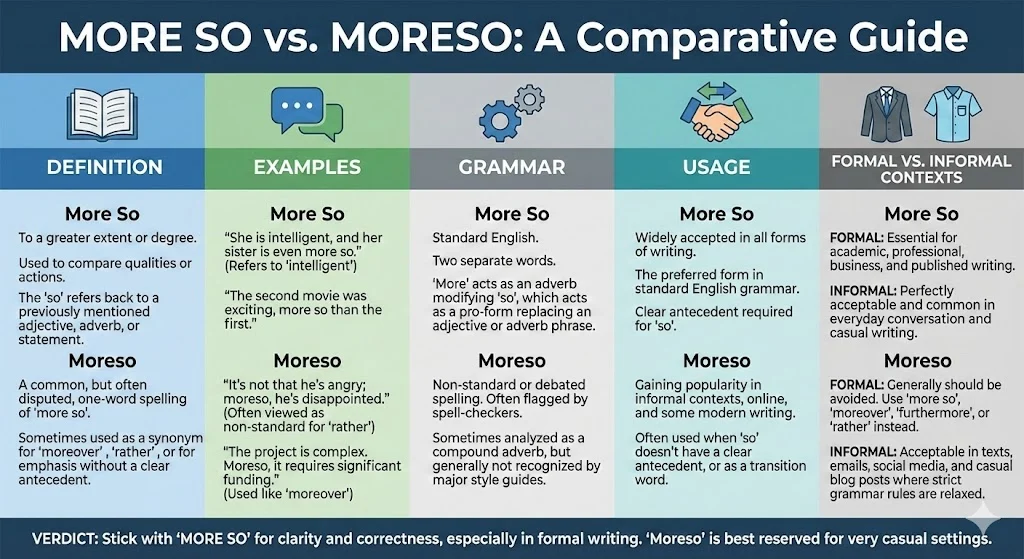
“More so” is the grammatically correct, standard English phrase used to indicate that something applies to a greater degree than previously mentioned. “Moreso” is a nonstandard, informal variant often seen in casual writing or social media. Always use “more so” in professional, academic, or formal contexts.
1. Why Understanding “More So vs Moreso” Matters
English is full of subtle nuances. Small differences in spelling or phrase choice can affect clarity, professionalism, and credibility.
The distinction between “more so” and “moreso” is one such nuance. While they share the same general meaning—indicating a greater degree—one is standard and formal, and the other is informal and nonstandard.
Using the incorrect form in professional writing can reduce credibility. Correct usage enhances clarity, engages readers, and ensures your content aligns with SEO and AI/NLP readability standards.
2. What Does “More So” Mean?
Definition:
“More so” is a two-word adverbial phrase used to emphasize that something applies to a greater degree than previously mentioned.
Key Characteristics:
- Standard English
- Common in formal, academic, and professional writing
- Functions as an adverbial intensifier
Examples:
- “She loves reading novels, but she enjoys historical fiction more so.”
- “Transparency is important in business, and honesty is valued more so during client onboarding.”
Grammar Tip: Always ensure the clause modified by “more so” is clear to avoid ambiguity.
3. What Does “Moreso” Mean?
Definition:
“Moreso” is a single-word, informal variant of “more so.”
Key Characteristics:
- Informal and casual
- Common in social media, blogs, and text messages
- Considered nonstandard in formal writing
Examples:
- “I like hiking; moreso, I enjoy camping in the mountains.”
- “He’s a good teacher; moreso, he inspires his students to think critically.”
While readers generally understand the meaning, moreso is not recommended in academic or professional contexts.
4. Key Differences Between the Two
| Feature | More So | Moreso |
|---|---|---|
| Word Count | Two words | One word |
| Grammar | Standard | Nonstandard |
| Formality | Formal / professional | Informal / casual |
| NLP Tokenization | Two tokens | Single token |
| Acceptance in Writing | Widely accepted | Often flagged as incorrect |
| Common Context | Academic, professional | Texting, social media |
| SEO & AI Implication | Preferred | May reduce credibility |
Takeaway: Always choose more so in professional or formal writing.
5. Historical Context: How “More So” Evolved
Origins:
- “More so” dates back to 17th-century English literature.
- It was used to emphasize statements and indicate comparative degree.
Why “Moreso” Appeared:
- Digital communication merged the words for convenience.
- Blogs and social media popularized “moreso,” but style guides like Oxford, Cambridge, and Chicago Manual of Style still endorse “more so.”
Fun Fact: Even classic literature sometimes split or hyphenated adverbial phrases for rhythm, but moreso as one word is modern.
6. Real-World Usage Examples
Academic Context
- ✅ “The survey highlighted a preference for renewable energy, more so among millennials.”
- ❌ “The survey highlighted a preference for renewable energy, moreso among millennials.”
Business and Professional Writing
- ✅ “Clients value transparency, more so during contract negotiations.”
- ❌ “Clients value transparency, moreso during contract negotiations.”
Social Media, Texts, and Blogs
- “I love pizza, morreso the extra cheese kind 😋” – Acceptable informally.
- “I enjoy movies, but moreso, I love documentaries.” – Casual tone.
Literary Examples
- Jane Austen or Charles Dickens:
“He admired the countryside, and the rolling hills more so than the bustling town.”
Tip: Context matters. “More so” = formal, “moreso” = casual.
7. Common Mistakes Writers Make
- Using “moreso” in formal writing – decreases credibility.
- Failing to refer to a prior idea – “more so” must amplify a previously stated point.
- Incorrect sentence placement:
- Correct: “I enjoy hiking, more so in the mountains.”
- Incorrect: “More so, I enjoy hiking in the mountains.”
- Assuming synonyms – “more so” is not interchangeable with “even more.”
- Ignoring grammar tools – AI and NLP editors often flag “moreso” as incorrect.
8. AI Perspectives
| Term | Tokenization | POS Tag | Recognition Notes |
|---|---|---|---|
| More so | “More” + “so” | ADV | Correctly parsed by AI tools |
| Moreso | “Moreso” | ADV | May be flagged as unknown or informal |
SEO Implications:
- Using more so ensures readability and proper parsing by search engines.
- Using moreso may affect grammar scores and credibility signals.
9. Social Media and Digital Trends
- US English: “More so” dominates formal writing; “moreso” appears casually.
- UK English: “More so” is standard; “moreso” rarely appears.
- TikTok, Instagram, Twitter: “Moreso” is growing due to informal tone and brevity.
Tip: For professional audiences, always use more so. For casual blogs, clarify that moreso is informal.
10. Writing Tips for Correct Usage
- ✅ Check context: Formal vs. casual writing.
- ✅ Default to “more so”: safe for all readers.
- ✅ Refer to a prior idea: “More so” intensifies existing statements.
- ✅ Ensure clarity: Place “more so” where it clearly modifies a prior clause.
- ✅ AI and SEO friendly: “More so” is recognized by grammar and search algorithms.
- ✅ Use examples: Helps readers understand nuances.
- ✅ Break into bullets and short paragraphs: Improves readability.
- ✅ Highlight takeaways in bold: Enhances skimmability.
11. FAQs About “More So” vs “Moreso”
Q1: Can “moreso” be used in formal writing?
- No. Stick to more so for professional, academic, or published content.
Q2: Is “more so” only used in comparisons?
- Yes. It indicates a greater degree of something previously mentioned.
Q3: Can “more so” start a sentence?
- Rarely. Best used to refer back to a prior clause.
- “I enjoy reading, more so historical novels.”
Q4: How do AI grammar checkers treat “moreso”?
- Tools like Grammarly flag it as incorrect and suggest more so.
Q5: Is “more so” recognized by NLP systems for SEO?
- Yes. Tokenized correctly, parsed as an adverbial phrase, improving content clarity.
Q6: Is “moreso” acceptable in blogs or social media posts?
- Yes, but it should be clarified as informal to avoid confusion in professional writing.
12. Conclusion
Understanding the difference between “more so” and “moreso” is essential for writing clarity, professionalism, and SEO optimization.
- More so: Standard, formal, and correct. Use in academic, professional, and published content.
- Moreso: Informal, nonstandard, suitable only for casual or social media contexts.
Key Takeaways:
- Stick to more so for credibility and SEO.
- Use examples, tables, and bullet points for clarity.
- Include FAQs and structured headings to improve search engine visibility.
Mastering this distinction ensures polished, professional, and reader-friendly writing across all platforms.