
If you’ve been scrolling through Twitter, TikTok, or Instagram and stumbled upon the word “bomboclat” paired with an image and a request for captions, you might be wondering: What does this actually mean? Is it just another internet meme, or does it have a deeper cultural significance?
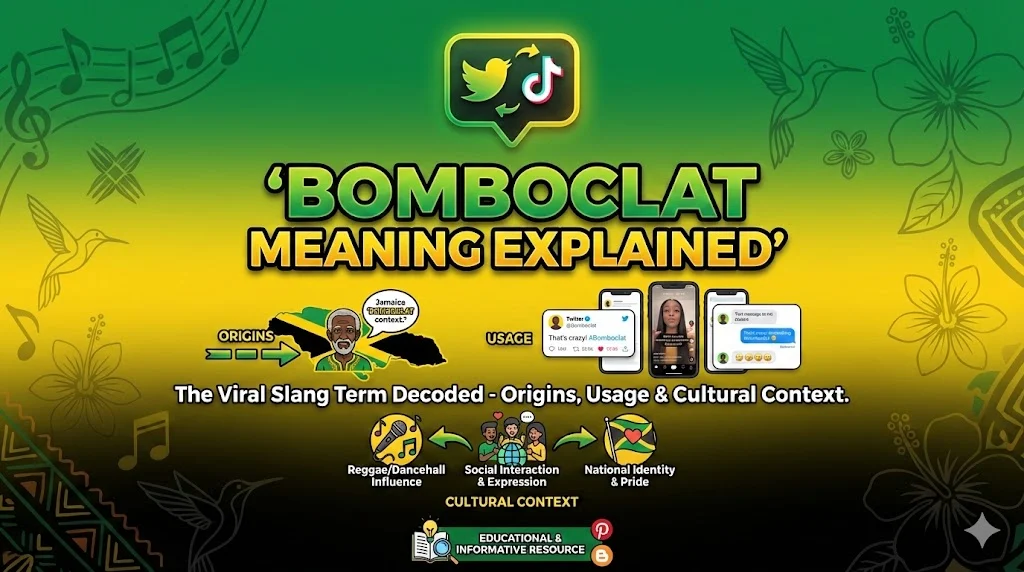
Quick Definition: Bomboclat (also spelled bumbaclot, bumbaclaat, or bumbclaat) is a Jamaican Patois expletive that literally translates to “bottom cloth” or menstrual pad. In its original context, it’s a profane curse word used to express anger, frustration, or surprise. On social media, however, it evolved into a popular meme format where users post images with “bomboclat” and ask followers to caption them.
Whether you’re trying to understand the slang you see online, curious about Jamaican culture, or wondering if you should use this term yourself, this comprehensive guide will break down everything you need to know about bomboclat—from its linguistic roots to its viral internet fame.
Understanding the Cultural Origins of Bomboclat
The Jamaican Patois Connection
Bomboclat originates from Jamaican Patois (also called Jamaican Creole), an English-based creole language with West African influences spoken predominantly in Jamaica. The term is a combination of two words:
- “Bumba” (or “bumbo”) – referring to the bottom or buttocks
- “Claat” (or “clot”) – meaning cloth
Historically, “claat” referred to the cloth used for menstruation before modern sanitary products were available. When combined, the term became a vulgar expletive in Jamaican culture, comparable in intensity to various strong profanities in English.
Cultural Significance and Context
In Jamaica and throughout Caribbean diaspora communities, bomboclat functions as:
- An exclamation of anger or frustration (similar to how someone might curse when upset)
- An expression of surprise (like saying “What the…!”)
- An intensifier to emphasize a point
- A versatile curse word that can be used in various emotional contexts
Important Cultural Note: While the term has been playfully adopted by internet culture, it remains a serious profanity in Jamaican Patois. Many Jamaicans and Caribbean people find its casual use by those outside the culture to be disrespectful or appropriative, especially when users don’t understand its weight or origins.
How Bomboclat Became a Viral Internet Meme
The 2019 Twitter Explosion
In August and September 2019, bomboclat exploded across Twitter as part of a caption meme format. The trend worked like this:
- A user posts an image (usually a relatable scenario, funny moment, or pop culture reference)
- They caption it with “Bomboclat” or “_____ bomboclat”
- Followers respond with creative, funny, or relatable captions describing the image
This format mirrored earlier meme trends like “sco pa tu manaa” (a phrase from a Ghanaian song that became a caption meme) and “bomboclat” quickly became one of the most viral variations.
Why It Went Viral
Several factors contributed to bomboclat’s viral success:
- Catchy sound: The word itself is phonetically interesting and memorable
- Mystery factor: Many users didn’t know what it meant, creating curiosity
- Interactive format: Caption memes encourage engagement and participation
- Celebrity participation: Various influencers and celebrities joined the trend
- Cross-platform spread: It jumped from Twitter to Instagram, TikTok, and Facebook
The Controversy
The meme’s popularity sparked significant backlash from Jamaican Twitter users and Caribbean communities who pointed out:
- The term is a serious profanity, not a joke
- Many users were appropriating Caribbean culture without understanding it
- The casual use trivialized an important aspect of Jamaican linguistic heritage
- People were using the word incorrectly and disrespectfully
This led to educational threads explaining the term’s true meaning and calling for more cultural awareness.
How to Actually Use Bomboclat (Original Context)
Traditional Jamaican Usage
In authentic Jamaican Patois, bomboclat is used as:
1. An Exclamation of Frustration:
- “Bomboclat! Mi phone dead again!” (Damn it! My phone died again!)
- Used when something goes wrong or is annoying
2. An Expression of Shock or Disbelief:
- “Bomboclat, yuh see wah happen?” (Holy crap, did you see what happened?)
- Similar to “What the hell!” or “Oh my God!”
3. As an Intensifier:
- “Dat bomboclat ting nuh work!” (That damn thing doesn’t work!)
- Adds emphasis and frustration to a statement
4. In Anger Directed at Someone:
- Used when extremely angry (not appropriate to provide direct examples of insults)
Grammatical Variations
The term appears in several spelling variations:
- Bomboclat
- Bumbaclot
- Bumbaclaat
- Bumboclaat
- Bumbclaat
All variations carry the same meaning and intensity.
Internet Meme Usage vs. Authentic Usage
The Meme Format
How it’s used online:
- Caption meme format
- Posted with images for comedic effect
- Often by people who don’t speak Patois
- Treated as a trendy phrase rather than profanity
The Cultural Disconnect
| AspectOriginal Jamaican UsageInternet Meme Usage | ||
|---|---|---|
| Intent | Serious expletive/curse | Funny caption game |
| Context | Emotional expression | Entertainment/engagement |
| Understanding | Native speakers know weight | Often used without knowing meaning |
| Appropriateness | Considered very vulgar | Treated casually |
| Cultural awareness | Deep linguistic roots | Surface-level trend |
Related Terms and Similar Expressions
Other Jamaican Patois Profanities
Bomboclat belongs to a family of Patois curse words that use “claat” (cloth):
- Pussyclaat – Similar profanity, considered extremely vulgar
- Bloodclaat – Another cloth-based expletive, very offensive
- Raasclaat (or Rassclaat) – Comparable in intensity and usage
Note: All of these terms share similar origins and are considered strong profanities in Jamaican culture.
Comparison with English Slang
To understand the intensity, bomboclat is roughly equivalent to:
- The F-word in English
- Strong profane exclamations
- Vulgar expressions of extreme emotion
It’s NOT equivalent to mild slang like “dang,” “shoot,” or “heck.”
Similar Internet Caption Memes
- “Sco pa tu manaa” – Ghanaian song lyric used as caption meme
- “Alhamdulillah” – Arabic phrase misused in meme format
- “And I oop” – Phrase popularized by VSCO culture
- “Periodt” – AAVE term adopted broadly online
When (and When Not) to Use Bomboclat
✅ When It Might Be Appropriate
- If you’re Jamaican or Caribbean and using it in its proper cultural context
- In discussions about language and internet culture (educational context)
- When quoting or referencing the meme phenomenon
- In creative works that accurately represent Jamaican culture (with proper cultural sensitivity)
❌ When You Should Avoid It
- Professional settings – It’s profanity, not workplace-appropriate
- Formal writing – Unless discussing it academically
- Around people who might be offended – Especially Jamaican or Caribbean people who find its casual use disrespectful
- As a trendy word without understanding – Cultural appropriation concerns
- In front of children – It’s vulgar language
- When you don’t speak Patois – Using it incorrectly can be offensive
Cultural Sensitivity Considerations
Before using bomboclat, ask yourself:
- Do I understand its actual meaning and cultural weight?
- Am I appropriating Caribbean culture for internet clout?
- Would I use strong profanity in this situation normally?
- Could this offend someone from the Jamaican community?
- Am I using it respectfully or as a joke at the culture’s expense?
Polite and Professional Alternatives
If you want to express similar sentiments without using profanity or culturally specific terms:
For Expressing Frustration:
- “Oh no!”
- “Seriously?!”
- “You’ve got to be kidding me!”
- “That’s frustrating!”
- “Ugh, not again!”
For Expressing Surprise:
- “Wow!”
- “No way!”
- “I can’t believe it!”
- “That’s incredible!”
- “Oh my goodness!”
Social Media Engagement:
- “Caption this!”
- “What would you say here?”
- “Describe this moment”
- “Your thoughts?”
- “Comment below!”
For Emphasis:
- “That really…”
- “This seriously…”
- “Absolutely…”
- “Definitely…”
Real-World Examples and Context
Example Scenarios Table
| Situation | Original Patois Use | Internet Meme Use | Professional Alternative |
|---|---|---|---|
| Phone breaks | “Bomboclat, not again!” | [Broken phone image] “Bomboclat” | “Oh no, my phone!” |
| Unexpected news | “Bomboclat! Yuh serious?” | N/A (less common) | “What? Really?” |
| Meme caption | Not applicable | [Relatable image] + “Bomboclat” | “Caption this situation” |
| Traffic jam | “Bomboclat traffic!” | N/A | “This traffic is terrible!” |
| Test results | Not typical usage | [Bad grade image] “Bomboclat” | “Well, that didn’t go well” |
The Impact on Jamaican Language and Culture
Linguistic Appropriation Concerns
The viral spread of bomboclat highlights ongoing tensions around:
- Cultural appropriation vs. appreciation – Taking words from marginalized cultures without respect
- Digital colonialism – The internet’s tendency to extract and commodify cultural elements
- Language ownership – Who has the right to use certain words and in what contexts
- Meaning dilution – How viral trends can strip words of their cultural significance
Jamaican Community Responses
Many Jamaicans and Caribbean people have expressed:
- Frustration at seeing their language turned into a joke
- Concern about misrepresentation of their culture
- Desire for education rather than appropriation
- Pride in their linguistic heritage
Positive Outcomes
Despite controversy, the trend also:
- Sparked conversations about Jamaican Patois
- Increased interest in Caribbean culture and language
- Created opportunities for cultural education
- Highlighted the global influence of Jamaican language
FAQs
1. What does bomboclat literally mean?
Bomboclat literally translates to “bottom cloth” or menstrual cloth in Jamaican Patois. Historically, “claat” referred to cloth used for menstruation. The term evolved into a strong profanity used to express anger, frustration, or surprise, comparable to serious curse words in English.
2. Is bomboclat a bad word?
Yes, bomboclat is considered a vulgar and profane word in Jamaican Patois. It’s equivalent to strong curse words in English and is generally inappropriate for polite conversation, professional settings, or formal contexts. In Jamaica, it’s taken very seriously as a profanity.
3. How do you pronounce bomboclat?
Bomboclat is pronounced “BUM-boh-clot” with emphasis on the first syllable. The “a” sounds are short (like “ah”), and the “o” is pronounced like in “cloth.” Variations in spelling (bumbaclot, bumboclaat) may have slightly different pronunciations but all sound similar.
4. Why did bomboclat become a meme?
Bomboclat became a viral meme in 2019 when Twitter users adopted it as a caption format, posting images with “bomboclat” and asking for creative captions. Its catchy sound, mystery factor (many didn’t know what it meant), and interactive format made it spread rapidly across social media platforms.
5. Is it offensive to use bomboclat if I’m not Jamaican?
Many Jamaican and Caribbean people consider it offensive or disrespectful when non-Jamaicans use bomboclat casually, especially as part of internet memes. It’s seen as cultural appropriation—taking a serious profanity from their language and using it without understanding its weight or cultural significance. If you’re not Jamaican or Caribbean, it’s generally best to avoid using it.
6. What’s the difference between bomboclat, bloodclaat, and raasclaat?
These are all Jamaican Patois profanities with similar structures and intensity levels. “Bomboclat” refers to bottom cloth, “bloodclaat” to blood cloth (menstrual cloth), and “raasclaat” to rear/bottom cloth. All are considered very vulgar and are used to express strong emotions like anger or surprise. They’re roughly equivalent in offensiveness.
7. Can I use bomboclat in everyday conversation?
Unless you’re Jamaican or Caribbean and using it in its proper cultural context, you should avoid using bomboclat in everyday conversation. It’s profanity, culturally specific, and can offend people. In professional settings, formal situations, or around people who might find it disrespectful, definitely avoid it. When in doubt, use non-profane alternatives.
8. What should I say instead of bomboclat?
Instead of bomboclat, use appropriate expressions for your context: For frustration, try “oh no,” “seriously,” or “that’s annoying.” For surprise, use “wow,” “no way,” or “I can’t believe it.” For social media engagement, try “caption this” or “what would you say?” These alternatives convey similar sentiments without cultural appropriation or profanity concerns.
Key Takeaways and Conclusion
What You Should Remember
Understanding bomboclat requires recognizing both its cultural roots and internet evolution:
- It’s a real profanity – Not just internet slang, but a serious Jamaican Patois curse word
- Cultural context matters – The term carries weight and history in Caribbean communities
- Internet usage differs from authentic usage – The meme format doesn’t reflect how it’s actually used in Patois
- Respect is essential – Using it casually can be seen as cultural appropriation
- Education over appropriation – Learn about the language and culture rather than just adopting trendy words
Final Thoughts
The bomboclat phenomenon perfectly illustrates how internet culture intersects with linguistic heritage, cultural appropriation, and global communication. While viral trends can spread words worldwide in hours, they often strip away the cultural context and significance that give those words meaning.
If you encounter bomboclat online or in conversation, now you understand both what it means and why it matters. Whether you’re a language enthusiast, social media user, or simply curious about viral slang, the most important thing is to approach words from other cultures with respect, awareness, and willingness to learn.
Remember: The best way to appreciate any culture is through genuine education and respectful engagement, not by turning sacred or significant elements into casual trends. If you’re interested in Jamaican Patois, consider learning about the language properly, understanding its history, and appreciating the rich cultural heritage it represents.
When in doubt, ask yourself: Am I using this word respectfully and appropriately, or am I treating someone’s language as a trend? The answer will guide you toward more culturally conscious communication.